Solid waste management in a higher education institution in the western Amazon, Brazil
DOI:
https://doi.org/10.47456/bjpe.v10i4.46015Keywords:
Management, Solid Waste, UniversityAbstract
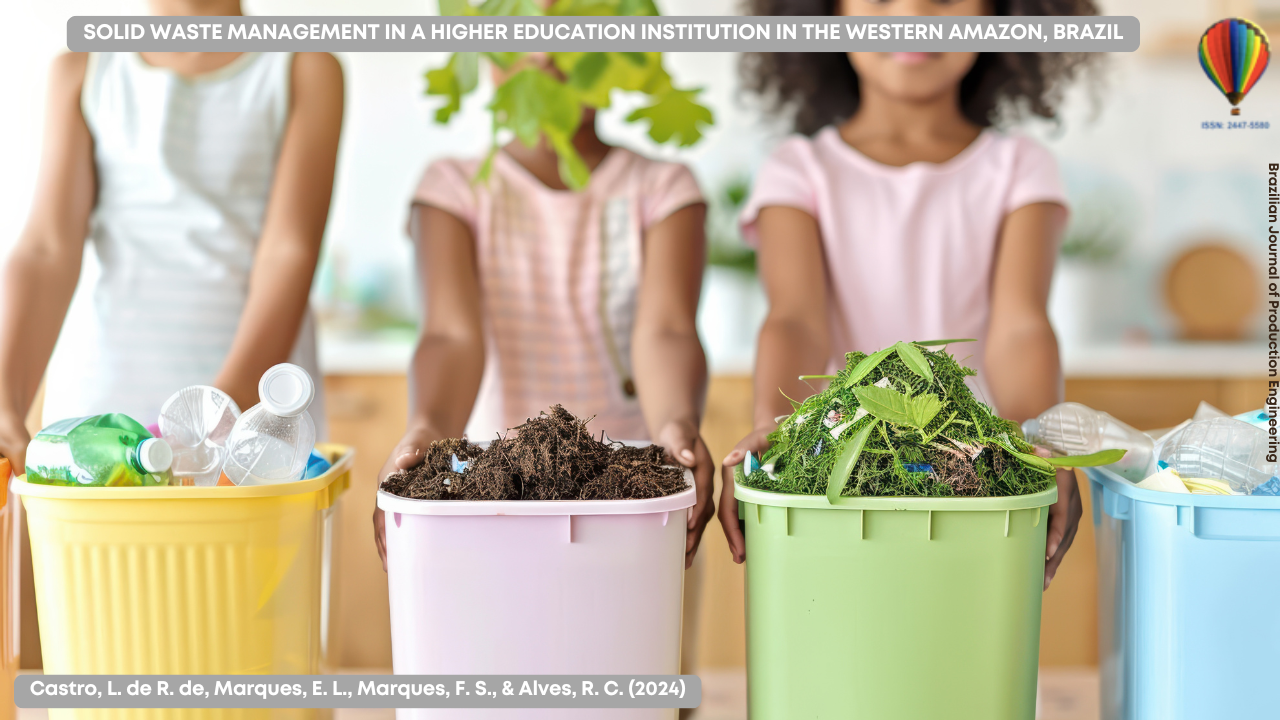
Waste generation in universities has become a challenge over the years, mainly due to the lack of correct management. The present study aims to analyze the management of solid waste at a higher education institute (HEI) located in Amazonas. In the first stage, solid waste gravimetry was carried out at three different moments. Next, each stage of waste management was analyzed, including segregation, packaging, internal transport, temporary storage, collection and external transport and final disposal. It was found that the IES generates 44.56% of organic waste, 36.18% of recyclable materials, and 19.23% of waste equivalent to waste generated. In the analysis of the waste management system, it was found that the IES needs adjustments such as the destination of waste and the care taken with the collection of hazardous waste. With a positive evaluation, the collection of recyclables is carried out by the municipality's collectors' association and the correct disposal of hazardous waste, which takes place by a licensed company. Therefore, it is understood that IES has a functioning waste management system, but that it still needs improvements.
Downloads
References
Associação Brasileira de Resíduos e Meio Ambiente. (2023). Panorama dos resíduos sólidos no Brasil. Recuperado de https://www.abrema.org.br/panorama/
Almeida, E. (2020). Perdas pós-colheita de frutas e hortaliças no Maranhão: estimativas, causas, impactos e soluções. Vol. 1, 1ª ed. 160p. São Luis: Edufma.
Dias, G. S. (2022). Coleta Seletiva de Resíduos Sólidos Urbanos: Experiencias Internacionais e Nacionais. Vol.1, 1ª ed. 218p.
Universidade Santo Amaro - UNISA. p. 113. São Paulo: Blucher.
Filártiga, M. & Kós, J. R. (2023). Projeto regenerativo para campus universitário. thesis. Thésis revista da anparq, 7, 90-104. Recuperado de https://doi.org/10.51924/revthesis.2023.v4.441
Galvão, G. (Ed.). (2004). Anuário de propaganda. São Paulo: Meio & Mensagem.
GOMES, L. P. (Ed.). (2010). Gestão de Resíduos em Universidades. Caxias do Sul: Educs.
Kitzmann, D. I. S. & Anello, L. F. S. (2014). Da política pública à política ambiental: a emergência da sustentabilidade nos sistemas universitários federais. Cap.3, 241-253pp. São Carlos: Plural.
Machado, R. E., Fracasso, E. M., Tometich, P., & Nascimento, L. F. (2013). Práticas de Gestão Ambiental em Universidades Brasileira. Revista de Gestão Social e Ambiental – RGSA. 7, 37-5. https://doi:10.5773/rgsa.v7i3.740
Nascimento, N. V., Lima, F.R.G., Portela, F.F., Sousa, J.L.C., & Júnior, C.A.C. (2021). A gestão de resíduos sólidos no Nordeste Urbano. Research, Society and Development. 10(11), 1-12. http://dx.doi.org/10.33448/rsd-v10i11.19431
Pinheiro, J. M. A.(2020). Plano de gerenciamento de resíduos químicos do Laboratório de Química Analítica Qualitativa do Departamento de Química Analítica e Físico-Química do Centro de Ciências da UFC (Trabalho de conclusão de curso). Universidade Federal do Ceará, Fortaleza, Ceará, Brasil.
Planalto. (2010). Política nacional de resíduos sólidos. Recuperado de https://www.planalto.gov.br/ccivil_03/_ato2007-2010/2010/lei/l12305.htm
Sá, J.S. (2012). Disposição Final de Resíduos. 1ª ed. Sul-rio-grandense: uab/ifsul.
Teixeira, A, P. (2020). Diagnóstico do Gerenciamento de Resíduos de Serviços de Saúde gerados em Laboratórios de Ensino e de Pesquisa da Universidade Federal de São Carlos – campus de São Carlos – SP. (Dissertação de mestrado). Universidade Federal de São Carlos, São Carlos, SP, Brasil.
Downloads
Published
Issue
Section
License
Copyright (c) 2024 Lenimar de Rebouças de Castro, Evely Laranjeira Marques, Francinete Soares Marques, Rodrigo Couto Alves (Autor)

This work is licensed under a Creative Commons Attribution 4.0 International License.

All works published in the Brazilian Journal of Production Engineering (BJPE) are licensed under Creative Commons Attribution 4.0 International (CC BY 4.0).
This means that:
Anyone can copy, distribute, display, adapt, remix, and even commercially use the content published in the journal;
Provided that due credit is given to the authors and to BJPE as the original source;
No additional permission is required for reuse, as long as the license terms are respected.
This policy complies with the principles of open access, promoting the broad dissemination of scientific knowledge.


2.png)