Ruta de producción de biocombustibles a partir de corteza de macadamia: efecto de los parámetros en el índice de mezcla del lechos fluidizados
DOI:
https://doi.org/10.47456/bjpe.v9i1.40123Palabras clave:
Biomasa, Dinámica de fluidos, Energía, Segregación, SostenibilidadResumen
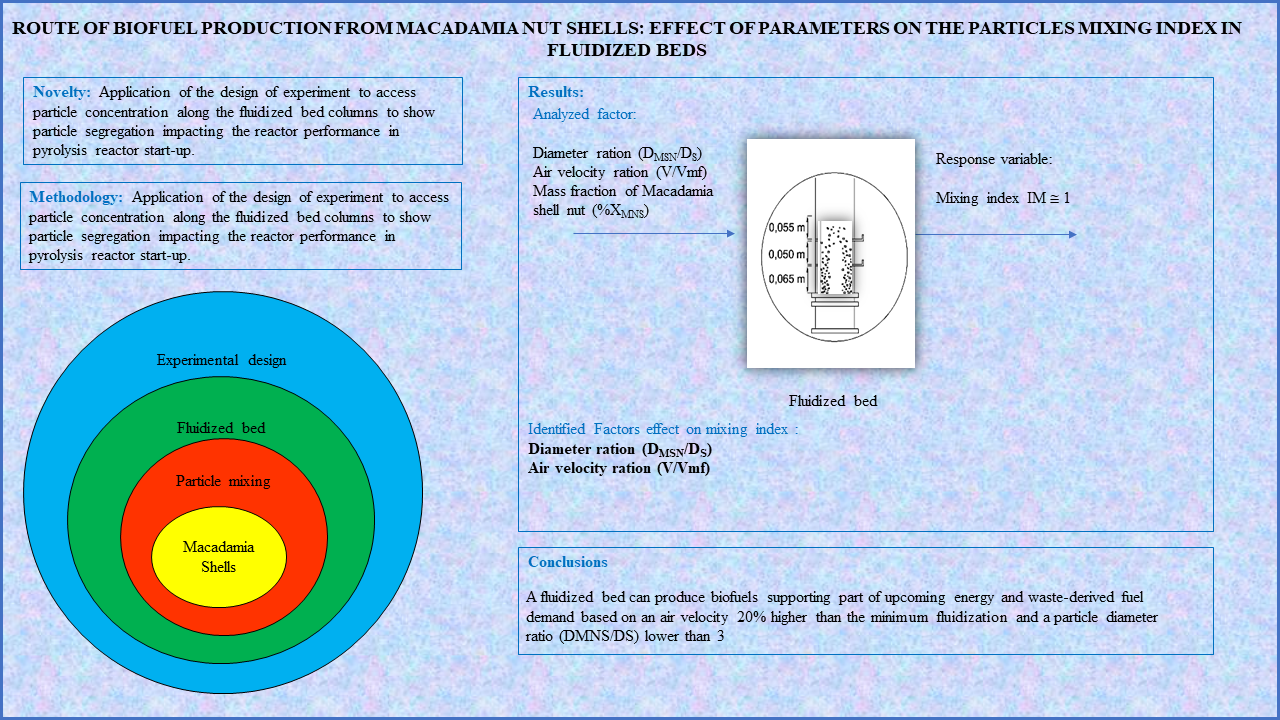
La pirólisis de corteza de macadamia (MNS) en un lecho fluidizado es un potencial para producir bio-aceite. El contacto efectivo gas-solido alcanza altas tasas de transferencia de calor y temperatura uniforme en el lecho. Aunque, las mezclas binarias pueden segregar partículas, eso reduce las tasas de transferencia de calor y masa. Por eso, se aplicó el diseño experimental para evaluar el efecto de los parámetros (velocidad de inyección del aire, V/VMF; relación del diámetro de partículas, DMNS/DS y fracción de masa, XMNS) en el índice de mezcla (Im) del lecho fluidizado compuesto por MNS y arena. El análisis de los datos reveló que solo DMNS/DS y V/VMF influenciaron en el índice de mezcla (Im), considerando un intervalo de confianza del 95%. Así, para velocidades de aire 20% arriba de la fluidización mínima y mezclas con DMNS/DS < 3, los lechos fluidizados mostraron concentraciones de partículas uniformes en toda la columna. Los resultados indican que el lecho fluidizado puede utilizarse en la producción de biocombustible a partir de la corteza de macadamia.
Descargas
Referencias
Artetxe, M., Lopez, G., Amutio, M., Elordi, G., Olazar, M., & Bilbao, J. (2010). Operating Conditions for the Pyrolysis of Poly-(ethylene terephthalate) in a Conical Spouted-Bed Reactor. Industrial & Engineering Chemistry Research, 49(5), 2064–2069. https://doi.org/10.1021/ie900557c DOI: https://doi.org/10.1021/ie900557c
Bacelos, M. S., & Freire, J. T. (2006). Stability of spouting regimes in conical spouted beds with inert particle mixtures. Industrial and Engineering Chemistry Research, 45(2). https://doi.org/10.1021/ie050633s DOI: https://doi.org/10.1021/ie050633s
Barcelos, K. M., Almeida, P. S., Araujo, M. S., Xavier, T. P., Santos, K. G., Bacelos, M. S., & Lira, T. S. (2020). Particle segregation in spouted bed pyrolysis reactor: Sand-coconut shell and sand-cocoa shell mixtures. Biomass and Bioenergy, 138, 105592. https://doi.org/10.1016/j.biombioe.2020.105592 DOI: https://doi.org/10.1016/j.biombioe.2020.105592
Daleffe, R. V., & Freire, J. T. (2004). Analysis of the fluid-dynamic behavior of fluidized and vibrofluidized bed containing glycerol. Brazilian Journal of Chemical Engineering, 21(1), 35–46. https://doi.org/10.1590/S0104-66322004000100005 DOI: https://doi.org/10.1590/S0104-66322004000100005
Freitas, T. M., Arrieche, L. S., Ribeiro, D. C., Gidaspow, D., & Bacelos, M. S. (2017). CFD analysis of fluidized beds using wastes from post-consumer carton packaging. Chemical Engineering and Processing: Process Intensification, 111, 89–100. https://doi.org/10.1016/j.cep.2016.12.002 DOI: https://doi.org/10.1016/j.cep.2016.12.002
Gong, Y., & Pegg, R. B. (2015). Tree nut oils: Properties and processing for use in food. Specialty Oils and Fats in Food and Nutrition: Properties, Processing and Applications, 65–86. https://doi.org/10.1016/B978-1-78242-376-8.00003-X DOI: https://doi.org/10.1016/B978-1-78242-376-8.00003-X
Hasan, M. M., Rasul, M. G., Jahirul, M. I., & Khan, M. M. K. (2022). Modeling and process simulation of waste macadamia nutshell pyrolysis using Aspen Plus software. Energy Reports, 8, 429–437. https://doi.org/10.1016/J.EGYR.2022.10.323 DOI: https://doi.org/10.1016/j.egyr.2022.10.323
Hidaka, N., Onitani, M., Matsumoto, T., & Shigeharu, M. (1995). Inverted segregation of binary particles in gas-liquid-solid fluidized bed. Powder Technology, 84, 157–163. DOI: https://doi.org/10.1016/0032-5910(95)02988-E
Iannello, S., Bond, Z., Sebastiani, A., Errigo, M., & Materazzi, M. (2023). Axial segregation behaviour of a reacting biomass particle in fluidized bed reactors: experimental results and model validation. Fuel, 338, 127234. https://doi.org/10.1016/J.FUEL.2022.127234 DOI: https://doi.org/10.1016/j.fuel.2022.127234
Ji, X., Bie, R., Chen, P., & Gu, W. (2016). Reed Black Liquor Combustion in Fluidized Bed for Direct Causticization with Limestone as Bed Material. Energy and Fuels, 30(7), 5791–5798. https://doi.org/10.1021/ACS.ENERGYFUELS.6B00847 DOI: https://doi.org/10.1021/acs.energyfuels.6b00847
José, M. J. S., Olazar, M., Peñas, F. J., & Bilbao, J. (1994a). Segregation in Conical Spouted Beds with Binary and Ternary Mixtures of Equidensity Spherical Particles. 1838–1844. https://doi.org/10.1021/ie00031a025
José, M. J. S., Olazar, M., Peñas, F. J., & Bilbao, J. (1994b). Segregation in Conical Spouted Beds with Binary and Ternary Mixtures of Equidensity Spherical Particles. 1838–1844. https://doi.org/10.1021/ie00031a025 DOI: https://doi.org/10.1021/ie00031a025
Lee, J., Kim, S., You, S., & Park, Y. K. (2023). Bioenergy generation from thermochemical conversion of lignocellulosic biomass-based integrated renewable energy systems. Renewable and Sustainable Energy Reviews, 178, 113240. https://doi.org/10.1016/J.RSER.2023.113240 DOI: https://doi.org/10.1016/j.rser.2023.113240
Lopez, G., Artetxe, M., Amutio, M., Bilbao, J., & Olazar, M. (2017). Thermochemical routes for the valorization of waste polyolefinic plastics to produce fuels and chemicals. A review. In Renewable and Sustainable Energy Reviews, 73, 346–368. Elsevier Ltd. https://doi.org/10.1016/j.rser.2017.01.142 DOI: https://doi.org/10.1016/j.rser.2017.01.142
López, G., Olazar, M., Aguado, R., & Bilbao, J. (2010). Continuous pyrolysis of waste tyres in a conical spouted bed reactor. Fuel, 89(8), 1946-1952. https://doi.org/10.1016/J.FUEL.2010.03.029 DOI: https://doi.org/10.1016/j.fuel.2010.03.029
Mantegazini, D. Z., Neves, F. L., Xavier, T. P., & Bacelos, M. S. (2021). Review on advanced technologies for aluminum recovery from carton packages waste using pyrolysis. Brazilian Journal of Production Engineering-BJPE, 7(1), 117–129. https://doi.org/10.47456/bjpe.v7i1.34583 DOI: https://doi.org/10.47456/bjpe.v7i1.34583
Marques, I. I. D. R., & Bacelos, M. S. (2013). Analysis of conical spouted bed fluid dynamics using carton mixtures. Chemical Engineering and Processing: Process Intensification, 70, 37–47. https://doi.org/10.1016/j.cep.2013.05.009 DOI: https://doi.org/10.1016/j.cep.2013.05.009
Martinez Castilla, G., Larsson, A., Lundberg, L., Johnsson, F., & Pallarès, D. (2020). A novel experimental method for determining lateral mixing of solids in fluidized beds – Quantification of the splash-zone contribution. Powder Technology, 370, 96–103. https://doi.org/10.1016/J.POWTEC.2020.05.036 DOI: https://doi.org/10.1016/j.powtec.2020.05.036
Massaro Sousa, L., & Ferreira, M. C. (2020). On the performance of a spouted bed type device for feeding spent coffee grounds to a circulating fluidized bed reactor. Chemical Engineering Research and Design, 160, 31–38. https://doi.org/10.1016/J.CHERD.2020.05.002 DOI: https://doi.org/10.1016/j.cherd.2020.05.002
Melo, J. L. Z., Bacelos, M. S., Pereira, F. A. R., Lira, T. S., & Gidaspow, D. (2016). CFD modeling of conical spouted beds for processing LDPE/Al composite. Chemical Engineering and Processing: Process Intensification, 108, 93–108. https://doi.org/10.1016/j.cep.2016.07.011 DOI: https://doi.org/10.1016/j.cep.2016.07.011
Norouzi, H. R., Mostoufi, N., & Sotudeh-Gharebagh, R. (2012). Effect of fines on segregation of binary mixtures in gas-solid fluidized beds. Powder Technology, 225, 7–20. https://doi.org/10.1016/j.powtec.2012.03.025 DOI: https://doi.org/10.1016/j.powtec.2012.03.025
Nunes, C. A., Freitas, M. P., Pinheiro, A. C. M., & Bastos, S. C. (2012). Chemoface: a novel free user-friendly interface for chemometrics. Journal of the Brazilian Chemical Society, 23(11), 2003–2010. https://doi.org/10.1590/S0103-50532012005000073 DOI: https://doi.org/10.1590/S0103-50532012005000073
Parikh, J., Channiwala, S. A., & Ghosal, G. K. (2005). A correlation for calculating HHV from proximate analysis of solid fuels. Fuel, 84(5), 487–494. https://doi.org/10.1016/J.FUEL.2004.10.010 DOI: https://doi.org/10.1016/j.fuel.2004.10.010
Saidi, M., Basirat Tabrizi, H., Chaichi, S., & Dehghani, M. (2014). Pulsating flow effect on the segregation of binary particles in a gas-solid fluidized bed. Powder Technology, 264, 570–576. https://doi.org/10.1016/j.powtec.2014.06.003 DOI: https://doi.org/10.1016/j.powtec.2014.06.003
Samoraj, M., Izydorczyk, G., Krawiec, P., Moustakas, K., & Chojnacka, K. (2022). Biomass-based micronutrient fertilizers and biofortification of raspberries fruits. Environmental Research, 215, 114304. https://doi.org/10.1016/J.ENVRES.2022.114304 DOI: https://doi.org/10.1016/j.envres.2022.114304
Selvatici, A. C., Mantegazini, D. Z., & Bacelos, M. S. (2021). Produção de combustível a partir de resíduos de embalagens tetra pak em leito fluidizado: identificação de fatores que afetam a mistura de partículas de areia e compósito PEBD/AL. Brazilian Journal of Production Engineering, 7(5), 133–144. https://doi.org/10.47456/BJPE.V7I5.36926 DOI: https://doi.org/10.47456/bjpe.v7i5.36926
Soria-Verdugo, A., Cano-Pleite, E., Passalacqua, A., & Fox, R. O. (2023a). Effect of particle shape on biomass pyrolysis in a bubbling fluidized bed. Fuel, 339, 127365. https://doi.org/10.1016/J.FUEL.2022.127365
Soria-Verdugo, A., Cano-Pleite, E., Passalacqua, A., & Fox, R. O. (2023b). Effect of particle shape on biomass pyrolysis in a bubbling fluidized bed. Fuel, 339. https://doi.org/10.1016/j.fuel.2022.127365 DOI: https://doi.org/10.1016/j.fuel.2022.127365
Soria-Verdugo, A., Rubio-Rubio, M., Goos, E., & Riedel, U. (2020). On the characteristic heating and pyrolysis time of thermally small biomass particles in a bubbling fluidized bed reactor. Renewable Energy, 160, 312–322. https://doi.org/10.1016/j.renene.2020.07.008 DOI: https://doi.org/10.1016/j.renene.2020.07.008
Strezov, V., Patterson, M., Zymla, V., Fisher, K., Evans, T. J., & Nelson, P. F. (2007). Fundamental aspects of biomass carbonisation. Journal of Analytical and Applied Pyrolysis, 79(1–2), 91–100. https://doi.org/10.1016/J.JAAP.2006.10.014 DOI: https://doi.org/10.1016/j.jaap.2006.10.014
Tchoffor, P. A., Davidsson, K. O., & Thunman, H. (2015). Production of Activated Carbon within the Dual Fluidized Bed Gasification Process. Industrial and Engineering Chemistry Research, 54(15), 3761–3766. https://doi.org/10.1021/IE504291C DOI: https://doi.org/10.1021/ie504291c
Tran, Q. K., Han, S., Ly, H. V., Kim, S. S., & Kim, J. (2020). Hydrodeoxygenation of a bio-oil model compound derived from woody biomass using spray-pyrolysis-derived spherical γ-Al2O3-SiO2 catalysts. Journal of Industrial and Engineering Chemistry, 92, 243–251. https://doi.org/10.1016/J.JIEC.2020.09.012 DOI: https://doi.org/10.1016/j.jiec.2020.09.012
Wang, S., Hu, C., Luo, K., Yu, J., & Fan, J. (2022). Multi-scale numerical simulation of fluidized beds: Model applicability assessment. Particuology. https://doi.org/10.1016/J.PARTIC.2022.11.011 DOI: https://doi.org/10.1016/j.partic.2022.11.011
Wang, S., & Shen, Y. (2021). Particle-scale study of heat and mass transfer in a bubbling fluidised bed. Chemical Engineering Science, 240, 116655. https://doi.org/10.1016/J.CES.2021.116655 DOI: https://doi.org/10.1016/j.ces.2021.116655
Xavier, T. P., Libardi, B. P., Lira, T. S., & Barrozo, M. A. S. (2016). Fluid dynamic analysis for pyrolysis of macadamia shell in a conical spouted bed. Powder Technology, 299, 210–216. https://doi.org/10.1016/J.POWTEC.2016.05.034 DOI: https://doi.org/10.1016/j.powtec.2016.05.034
Yang, C., Kwon, H., Bang, B., Jeong, S., & Lee, U. (2022). Role of biomass as low-carbon energy source in the era of net zero emissions. Fuel, 328, 125206. https://doi.org/10.1016/J.FUEL.2022.125206 DOI: https://doi.org/10.1016/j.fuel.2022.125206
Zhou, M., Wang, S., Luo, K., & Fan, J. (2022). Three-dimensional modeling study of the oxy-fuel co-firing of coal and biomass in a bubbling fluidized bed. Energy, 247, 123496. https://doi.org/10.1016/J.ENERGY.2022.123496 DOI: https://doi.org/10.1016/j.energy.2022.123496
Descargas
Publicado
Número
Sección
Licencia
Derechos de autor 2023 Brazilian Journal of Production Engineering

Esta obra está bajo una licencia internacional Creative Commons Atribución 4.0.

Todas las obras publicadas en la Revista Brasileña de Ingeniería de Producción (BJPE) están bajo la licencia Creative Commons Atribución 4.0 Internacional (CC BY 4.0).
Esto significa que:
Cualquier persona puede copiar, distribuir, exhibir, adaptar, remezclar e incluso utilizar comercialmente el contenido publicado en la revista;
Siempre que se reconozca debidamente a los autores y a BJPE como fuente original;
No se requiere permiso adicional para la reutilización, siempre que se respeten los términos de la licencia.
Esta política cumple con los principios de acceso abierto, promoviendo la amplia difusión del conocimiento científico.


2.png)