
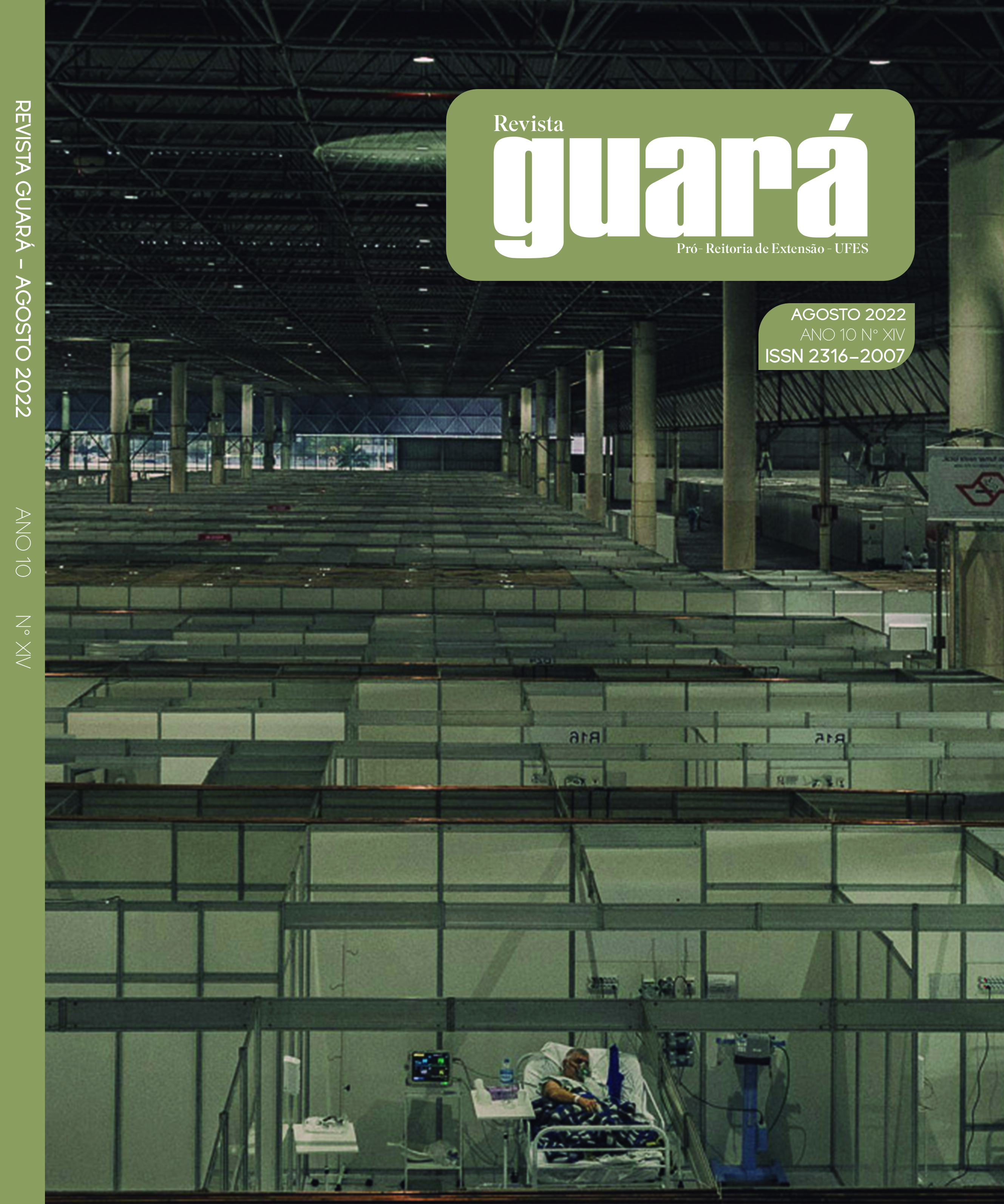
Remnants of a pandemic
Possibilities of educating in the face of loss and grief
DOI:
https://doi.org/10.30712/guara.v1i14.38657Keywords:
Grief, Childhoods, Children’s literature, Teacher trainingAbstract
This article presents the university extension course Pedagogies do Esperançar: the art of educating in the face of loss and grief, whose main objective was to provide a space for sharing knowledge and welcoming regarding losses and mourning. This training prioritized awakening the educators’ watchful eye to the protagonism and narratives of children/adolescents about their processes of elaboration of losses. Offered by the Study and Research Group on Children, Cultures, Education and Society - GEPICES/CEFET/RJ in a remote environment, the course welcomed one hundred and thirty participants, who were able to highlight the need to talk about individual and collective pain; about death and grief. There were four virtual meetings that dealt with different aspects related to the theme. Through theoretical expositions, dialogic interactions, storytelling and narration, among other activities, spaces were created for acti-ve listening, that is, for the sharing of perceptions and feelings, which, based on the Sociology of Childhood, could be elabo-rated, resignified. In their testimonies, participants highlighted the importance of the proposed activities that dared to work on issues that contemporaneity insists on hiding. In the end, the perception that pain needs to be elaborated was confirmed.
Downloads
References
ADICHIE, Chimamanda Ngozi. Notas sobre luto. São Paulo: Companhia das Letras, 2021. ANDRUETTO, María Teresa. Por uma literatura sem adjetivos. São Paulo: Pulo do Gato, 2012.
ARENDT, H. Entre o passado e o futuro. 6. ed. Trad. Mauro W. Barbosa. São Paulo: Perspectiva, 2011.
ARIÈS, Phillippe. História da Morte no Ocidente. Rio de Janeiro: Saraiva, 2012.
BAUMAN, Zygmunt. Tempos Líquidos. Rio de Janeiro: Zahar, 2007.
BRASIL, Ministério da Saúde. Painel Coronavirus, 2022.Disponível em: https:?covid.saude.gov.br/. Acesso em: 09.mai.2022
CHUL HAN, Byung. A sociedade paliativa: a dor hoje. Petrópolis, RJ: Vozes, 2021.
CORSARO, William. Sociologia da Infância. 2. ed. Porto Alegre: Artmed, 2011.
FRANCO, Maria Helena Pereira. O luto no século 21: uma compreensão abrangente do fenômeno.1. ed. São Paulo: Summus, 2021.
FREIRE, Paulo. Pedagogia da Esperança: um reencontro com a Pedagogia do Oprimido. Rio de Janeiro: Paz e Terra, 1992.
FRANKL, Viktor. Em busca de sentido. Petrópolis, RJ: Vozes, 1991.
MAGALHÃES, Silvana Bezerra de. O Reino do Aqui. Nova Friburgo-RJ: Sabor de Leitura, 2021.
MATSUSAKI, Ana. Colecionadora de Cabeças. São Paulo-SP: Editora do Brasil, 2020.
NASIO, Juan-David. A dor de amar. Rio de Janeiro: Zahar, 2007.
PAIVA, Lucélia Elizabeth. Arte de falar da morte para crianças: a literatura como recurso para abordar a morte com crianças e educadores. Aparecida, SP: Ideias & Letras, 2011.
TARDIN, Poliane. Ana e a Amoreira. São Paulo-SP: Amélie Editorial, 2022.
QVORTRUP, Jens. et al. Childhood matters: social theory, practice and politics. Aldershot: Avebury, 1994.
RINGTVED, Glenn e PARDI, Charlotte. Pode chorar, coração, mas fique inteiro. São Paulo: Companhia das Letrinhas, 2020.
SANTOS, Boaventura de Sousa, A Cruel Pedagogia do Vírus. Coimbra, Portugal: Edições Almedina S.A., 2020.
SIROTA, Régine. Emergência de uma sociologia da infância: evolução do objeto e do olhar. São Paulo: Cadernos de pesquisa, n.112,Mar/2001. Disponível em https://www.scielo.br/j/cp/a/X8n4RcnLnhdybsVSwNG5Twv/?for-mat=pdf&lang=pt. Acesso em: 08 abr. 2022.
SISTO, Celso. Textos & pretextos sobre a arte de contar histórias. 3ed. Belo Horizonte: Aletria, 2012.
TAVARES, Cláudia Mara de Melo. O impacto da Covid-19 na saúde mental. Edição Suplementar Covid-19. Onli-ne Brazilian Journal of Nursing (OBJN). 15set2021. Disponível em: https://www.objnursing.uff.br/index.php/nursing/article/view/6538. Acesso em: 22 jun. 2022.
VENDRUSCOLO, Juliana. Visão da Criança sobre a Morte. Medicina (Ribeirão Preto) [Internet]. 30 de março de 2005 [citado 22 de julho de 2022]; 38(1): 26-33. Disponível em: https://www.revistas.usp.br/rmrp/article/view/420 Acesso em: 22 jun. 2022.
VIEIRA, Mariana Amargós. A morte e a criança: a importância dos temas difíceis nos livros para infância. 2019. 29 f. TCC [especialização] - Pós-Graduação O Livro Para Infância, A Casa Tombada/FACCON, São Paulo, 2019.Disponível em: http://biblioteca.acasatombada.com.br/items/show/1716. Acesso em: 22 jun. 2022.
YALOM, Irvin D.; YALOM, Marilyn. Uma questão de vida e morte. São Paulo: Editora Planeta/Paidós, 2021.
Downloads
Published
Issue
Section
License
Copyright (c) 2022 Guará Journal

This work is licensed under a Creative Commons Attribution-NonCommercial-NoDerivatives 4.0 International License.
Revista Guará adopts the Creative Commons Attribution 4.0 International (CC BY 4.0) license, under which authors retain copyright over their submitted and published works.
Authors are responsible for declaring that the submitted manuscript is original, has not been previously published, and is not under simultaneous consideration by another journal. Upon submission, manuscripts undergo a peer review process.
By submitting a manuscript, authors grant Revista Guará the right of first publication, while remaining free to enter into additional non-exclusive distribution agreements for the published version (for example, in institutional repositories, personal websites, or as part of future works), provided that proper credit is given to the authors and to the original publication in the journal.
Revista Guará encourages the broad dissemination of published works, including their availability in institutional repositories and other platforms, as a way to increase the visibility and impact of scientific production.
Under the CC BY 4.0 license, users are allowed to:
- Share — copy and redistribute the material in any medium or format;
- Adapt — remix, transform, and build upon the material for any purpose, including commercial use.
These rights are irrevocable, provided that the following terms are respected:
- Attribution — appropriate credit must be given to the authors, a link to the license must be provided, and any changes made must be indicated. Attribution must be made in a reasonable manner, without suggesting endorsement by the authors or the journal.
The license does not impose additional restrictions. Users may not apply legal terms or technological measures that legally restrict others from exercising the rights granted by the license.