
Environmental education with Paneleiras de Goiabeiras
Sustainable use of red mangrove bark
DOI:
https://doi.org/10.30712/guara.v1i16.40789Keywords:
Mangrove, Bay of Vitória, Rhizophora mangle, TanninAbstract
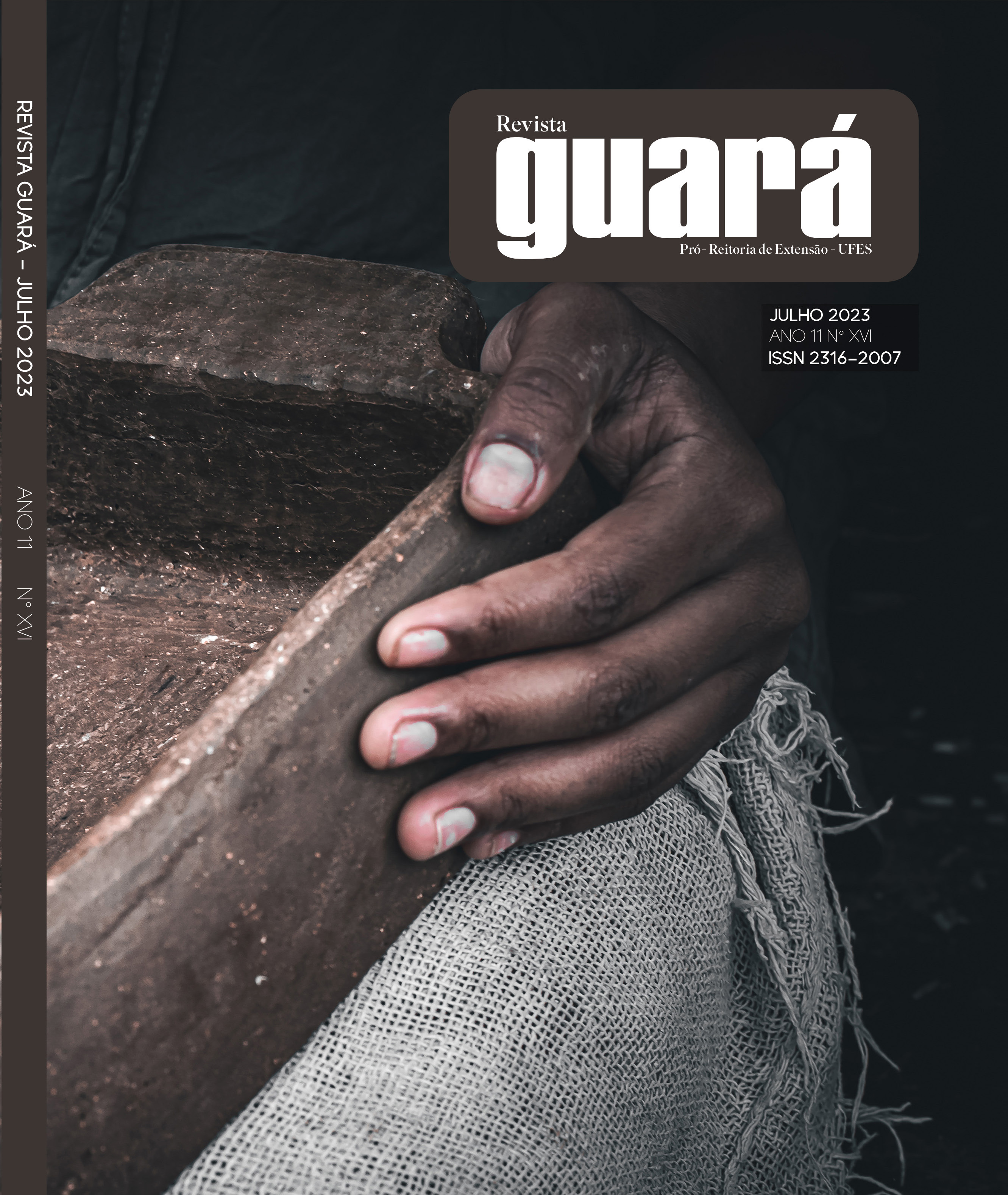
The “Paneleiras de Goiabeiras” in Vitória, ES, are traditional artisans who use bark from the Rhizophora mangle tree to paint clay pots. However, this practice has had a negative impact on mangroves, leading to the death of the trees. The “modus operandi” of making clay pots is the first intangible cultural heritage in Brazil. In 1997, extension and environmental education activities were carried out to develop participatory ecosystem management strategies. The focal group technique was used, along with interviews with 30 artisans and 3 bark collectors, to collect data. Two assessments were
conducted (March/2000 and March/2001) to monitor changes in attitudes and behaviors in the community. The bark extraction is done individually, and information about unexplored mangrove areas is not shared. After 20 months, it was found that the bark collectors continued to remove the bark, but this time, they chose mature trees with a higher concentration of tannins. The artisans also improved production planning, reducing waste, and increasing the efficiency of pot painting. It
is essential to involve institutions and civil society in a dialogue on the conservation of mangroves, including the Paneleiras de Goiabeiras. Preserving the ecosystem is crucial to ensure the continuity of this cultural tradition.
Downloads
References
ALMEIDA, R. Manguezal do Canal da Passagem, Vitória, Espírito Santo: Conteúdo e transferência de nutrientes na fração folhas da serapilheira. 2001. 92p. Dissertação de Mestrado. Instituto Oceanográfico da Universidade de São Paulo. 2001.
BARBIRATO, J.O.; FERREIRA, N.C.; ZANDONADI, D.B.; DOBBSS, L.B. Structural characterization of areas with different levels of conservation in the mangrove of Vitória Bay, ES. Brazilian Journal of Animal and Environmental Research. v.4, n.2, p.2600-2614, 2021.
CAMILETTI, G.G. Modernidade e Tradição em Anthony Giddens: um Olhar sobre os Estilos de Vida nas Paneleiras de Goiabeiras. Revista interdisciplinar de gestão social. v.1, n.2, p.165-188, 2012.
CARMO, T.M.S.; BRITO-ABAURRE, M.G.; SENNA-MELO, R.M.; ZANOTTIXAVIER, S.; COSTA, M.B.; HORTA, M.M.M. Os manguezais da baía norte de Vitória, Espírito Santo: um ecossistema ameaçado. Revista Brasileira de Biologia, v. 55, p. 801-808, 1995.
DIAS, C. Ser Paneleira não é brincadeira” - estratégias de associação política na construção de uma categoria profissional. Arquivos do Museu Nacional, Rio de Janeiro, v.64, n.3, p.203-213, 2006.
GATTI, B.A. Grupo focal na pesquisa em Ciências Sociais e Humanas. Brasília: Líber Livro, 2005.
IPHAN. Dossiê IPHAN 3 - Ofício das Paneleiras de Goiabeiras. Brasília, DF: Iphan, 2006.
LANKSHEAR, C.; KNOBEL, M. Pesquisa pedagógica: do projeto a Implementação. Porto Alegre: Artmed. 2008. 50
LIMA, T.L.M.; DANTAS, H.T.A.; COSTA, L.V.M.; GUIMARÃES, P.B.V. A indicação geográfica como alternativa para o desenvolvimento regional: o caso das panelas de barro de Goiabeiras. Cadernos de Prospecção, vol.8, n.1, p.169-173, 2015.
MARQUES, M.S. 2020. As Paneleiras de Goiabeiras Velha: Uma Análise Discursiva do Processo de Construção do Território da Tradição. Revista Brasileira de Sociologia, v.8, n.18, p.212-238, 2020.
MARQUES, M.S. As Paneleiras de Goiabeiras Velha e o “Outro” no processo de identificação dos sujeitos. Revista Sul-Americana de Ciência Política, v.7, n.1, p.79-104, 2021.
MARQUES, M.S.; CALOTI, V.A. As Paneleiras de Goiabeiras e a dinâmica da Cultura do Barro. Sociologia, Revista da Faculdade de Letras da Universidade do Porto, v. XXVI, p.163-185, 2013.
MARQUES, M.S.; RODRIGUES, L.H.; FUKUDA, R.F. A Associação das Paneleiras de Goiabeiras (APG): elementos para compreender o capital social e a cultura política. Simbiótica, v.8, n.4, p.257-289, 2021.
MIGUEL, M.C.; SILVEIRA, R.Z.; COSTA, R.P.F.; FREIRE, V.F. Visibilidade do ofício das Paneleiras de Goiabeiras: realidades, desafios e tendências. Revista Tecnologia e Sociedade. v.15, n.38, p.173-194, 2019.
NICOLE, B.C.; NASCIMENTO, J.C.; MARQUES, M.S.; COSTA, M.H.T.; PEREIRA, P.H.M.; PRADO, R.V.; CALOTI, V.A. As paneleiras de Goiabeiras e a arte de fazer panela de barro: Ensaio etnográfico sobre a cultura do barro. Simbiótica, v.1, n.1, pp.16-52, 2012.
PAIVA, D.S.; ALBINO, J. 2000. Estudo sedimentológico do material de fundo do sistema estuarino da região metropolitana de Vitória, ES. In: V Simpósio de ecossistemas brasileiros - Conservação, Vitória, Espírito Santo: ACIESP, v. II, p.206-211.
PEROTA, C., DOXSEY, J.R.; BELING NETO, R.A. As Paneleiras de Goiabeiras. (Memória Viva). Secretaria Municipal de Cultura, Vitória, 46p. 1997.
QUINTAS, J.S. Educação no processo de gestão ambiental: uma proposta de Educação Ambiental transformadora e emancipatória. In: Layrargues, P.P. (Coord.). Identidades da Educação Ambiental brasileira. Ministério do Meio Ambiente. Diretoria de Educação Ambiental. Brasília, DF, Edições MMA, p.113-140, 2004.
TRISTÃO, M. A Educação Ambiental e o pós-colonialismo. Revista de Educação Pública, v.23, n.53/2, p.473-489, 2014.
WALDECK, G. Dar de comer: panelas de barro de Goiabeiras. Funarte / CFCP. Rio de Janeiro, 1996.
ZAMPROGNO, G.C.; TOGNELLA, M.M.P.; QUARESMA, V.S.; COSTA, M.B.; PASCOALINI, S.S.; COUTO, G.F. The structural heterogeneity of an urbanised mangrove forest area in southeastern Brazil: Influence of environmental factors and anthropogenic stressors. Brazilian Journal of Oceanography, v.64, n.2, p.157-172, 2016.
Downloads
Published
Issue
Section
License
Copyright (c) 2023 Guará Journal

This work is licensed under a Creative Commons Attribution-NonCommercial-NoDerivatives 4.0 International License.
Revista Guará adopts the Creative Commons Attribution 4.0 International (CC BY 4.0) license, under which authors retain copyright over their submitted and published works.
Authors are responsible for declaring that the submitted manuscript is original, has not been previously published, and is not under simultaneous consideration by another journal. Upon submission, manuscripts undergo a peer review process.
By submitting a manuscript, authors grant Revista Guará the right of first publication, while remaining free to enter into additional non-exclusive distribution agreements for the published version (for example, in institutional repositories, personal websites, or as part of future works), provided that proper credit is given to the authors and to the original publication in the journal.
Revista Guará encourages the broad dissemination of published works, including their availability in institutional repositories and other platforms, as a way to increase the visibility and impact of scientific production.
Under the CC BY 4.0 license, users are allowed to:
- Share — copy and redistribute the material in any medium or format;
- Adapt — remix, transform, and build upon the material for any purpose, including commercial use.
These rights are irrevocable, provided that the following terms are respected:
- Attribution — appropriate credit must be given to the authors, a link to the license must be provided, and any changes made must be indicated. Attribution must be made in a reasonable manner, without suggesting endorsement by the authors or the journal.
The license does not impose additional restrictions. Users may not apply legal terms or technological measures that legally restrict others from exercising the rights granted by the license.