Diagnóstico inicial do aprendizado em projeto de iniciação científica júnior sobre educação ambiental
Palavras-chave:
Ensino Fundamental, Poluição, Meio Ambiente.Resumo
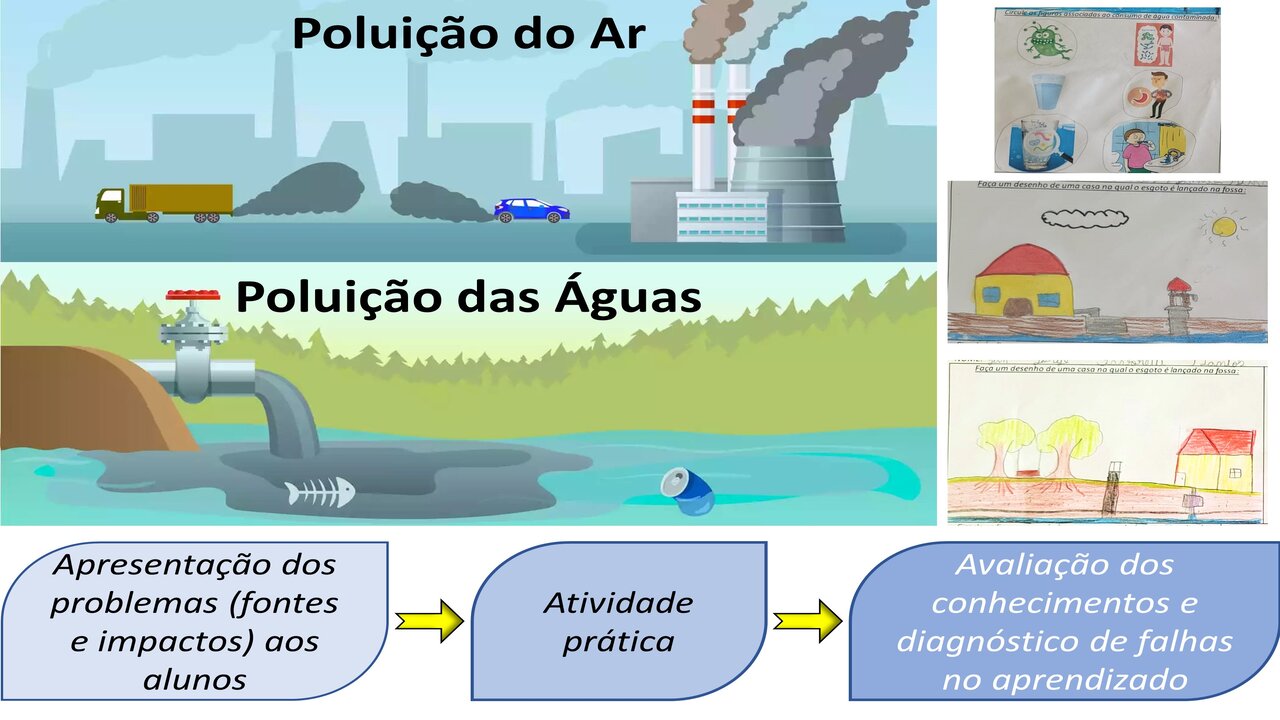
Conscientizar da importância de proteger o meio ambiente e sobre os impactos à saúde causados cotidianamente pela poluição do ar e da água ainda é necessário. Neste estudo, após oficinas teórico-práticas, o aprendizado de 26 alunos de uma turma do 3º ano do ensino fundamental foi avaliado. Estudou-se a poluição do ar com uma vela acesa, seguido do exame da fuligem produzida. Para a poluição das águas, murais para a fixação de imagens de elementos naturais, poluentes e medidas de mitigação foram empregados. Na sequência, os alunos coletaram e analisaram a água de suas casas, constatando que 100% das amostras de águas subterrâneas estavam contaminadas com patógenos. Depois de cada oficina, uma atividade avaliativa foi aplicada, revelando altos índices de acerto, sendo 100% nos exercícios sobre a poluição do ar e 70% sobre a poluição das águas. Concluiu-se que os alunos assimilaram os conteúdos discutidos teoricamente e aplicados nas práticas. Apesar de 30% não terem identificado todos os possíveis impactos sobre a saúde decorrentes da presença de patógenos na água, estes identificaram pelo menos um destes, o que demonstra uma boa compreensão do tema e que o projeto está obtendo sucesso em sua proposta.
Downloads
Referências
Agenda 2030. O Brasil e a Agenda 2030. Rumo aos Objetivos de Desenvolvimento Sustentável, 44p. Recuperado de https://brasilnaagenda2030.files.wordpress.com/2015/08/odstraduzidos.pdf
Brasil (2012). Ministério da Educação. Resolução do CNE nº 2, de 15 de junho de 2012. Estabelece as Diretrizes Curriculares Nacionais para a Educação Ambiental. Recuperado de http://portal.mec.gov.br/dmdocuments/rcp002_12.pdf
Cotta, A. J. B., Menezes, E. S., Rachid, M. D. S., & Hemerly, F. P. (2021b). Tratamento residencial da água, via cloração, em Guriri, São Mateus-ES. Anais do VIII ENCAQUI, Vitória, ES, Brasil, 1p.
Cotta, A. J. B., Silva, A. A, da., Souza, J. P. B., Livramento, J. L. do., Pirola, B. S., Menezes, E. S. de., & Bravo, I. D. N. (2022). Diagnóstico e desinfecção da água para uso residencial. Engenharia sanitária e ambiental: Recursos hídricos e tratamento de água, 2, 77-86.https://doi.org/10.22533/at.ed.8212222088
Cotta, A. J. B., Fachetti, P. S., & Andrade, R. P., de. (2021a). Characteristics and impacts on the groundwater of the Guriri beach resort, São Mateus, ES, Brazil. Environmental Development and Sustainability, 23, 10601-10622. https://doi.org/10.1007/s10668-020-01074-5
Gadoti, M. (2005). Pedagogia da Terra e cultura da sustentabilidade. Revista Lusófona de Educação, 6, 15-29.
Gomes, Y. L. & Pedroso, D. S. (2002) Metodologias de Ensino em Educação Ambiental no Ensino Fundamental: uma Revisão Sistemática. Revista Brasileira de Pesquisa em Educação em Ciências, 22, 1-33. https://doi.org/10.28976/1984-2686rbpec2022u321353
Guimarães, M. (2000). Educação ambiental, no consenso um embate?. Campinas- SP: Papirus, 2000. 94p.
Mizukami, M. G. N. (1992). Ensino: as abordagens do processo. São Paulo:EPU.
Nogueira, M. O. G. & Leal, D. (2015). Teorias da aprendizagem: um encontro entre os pensamentos filosófico, pedagógico e psicológico. 2ª ed. Curitiba: InterSaberes.
Silva, M. M. P., da. & Leite, V. D. (2008). Estratégias para realização de educação ambiental em escolas do ensino fundamental. REMEA - Revista Eletrônica do Mestrado em Educação Ambiental, 20, 372-392. https://doi.org/10.14295/remea.v20i0.3855
Xiang, X. & Meadows, M. E. (2020). Preparing adolescents for the uncertain future: concepts, tools, and strategies for teaching anthropogenic environmental change. Sustainability, 12 (17), 6832. http://dx.doi.org/10.3390/su12176832
Downloads
Arquivos adicionais
Publicado
Edição
Seção
Licença
Copyright (c) 2023 Aloísio José Bueno Cotta, Niccoly Aparecida Francelino, Bruna Moura Martins (Autor)

Este trabalho está licenciado sob uma licença Creative Commons Attribution 4.0 International License.

Todos os trabalhos publicados na Brazilian Journal of Production Engineering (BJPE) estão licenciados sob a Creative Commons Atribuição 4.0 Internacional (CC BY 4.0).
Isso significa que:
-
Qualquer pessoa pode copiar, distribuir, exibir, adaptar, remixar e até utilizar comercialmente os conteúdos publicados na revista;
-
Desde que sejam atribuídos os devidos créditos aos autores e à BJPE como fonte original;
-
Não é exigida permissão adicional para reutilização, desde que respeitados os termos da licença.
Esta política está em conformidade com os princípios do acesso aberto, promovendo a ampla disseminação do conhecimento científico.


2.png)