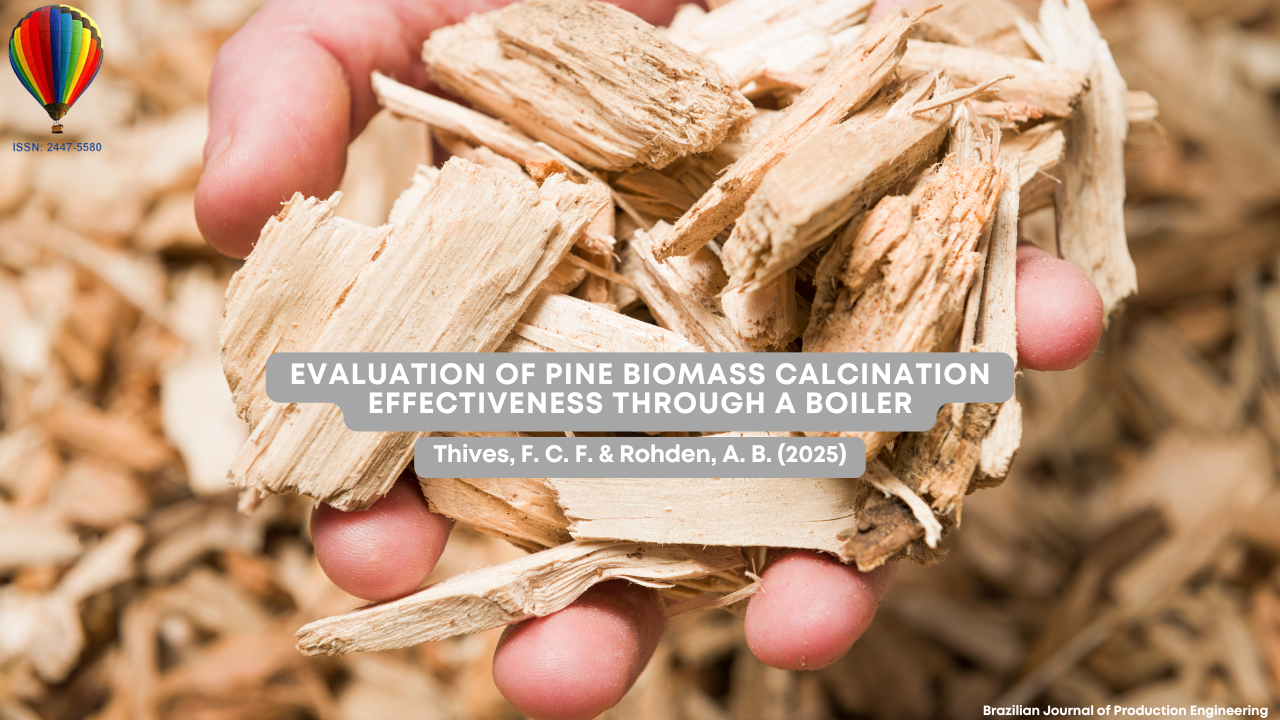
Evaluation of pine biomass calcination effectiveness through a boiler
DOI:
https://doi.org/10.47456/bjpe.v11i2.47697Keywords:
Biomass, Wood ash, Energy efficiencyAbstract
The search for alternatives that enable the use of renewable energy has become a major challenge regarding the effective use of all raw materials. Forest biomass has emerged as an economically viable option due to its abundance. Several companies use this material to generate thermal energy, yet there is an underuse of woody biomass. Therefore, the objective of this study was to evaluate the effectiveness of calcining pine biomass through its combustion in a boiler. The methodology consisted of a case study in a timber company that uses a boiler to generate thermal energy and this transformation generates wood ash. The ash was calcined at varying times and temperatures, investigating the homogeneity and efficiency of mass loss in each treatment. The results indicated that with longer times and temperatures better results were obtained, reaching complete homogenization of the ash sample with 5 hours and 700° C, as well as the same treatment being the most effective in mass loss with 44.34%. The conclusion showed that time was more effective than temperature, and that the ash studied was underused, having the potential to maximize thermal benefit.
Downloads
References
Agência Nacional de Energia Elétrica. (2008). Atlas de energia elétrica do Brasil: Edição. ANEEL. Recuperado de https://biblioteca.aneel.gov.br/Resultado/Listar?guid=1697320171191
Amaral, R. C. (2020). Substituição do cimento Portland por cinza volante proveniente da combustão de eucalipto citriodora sob diferentes beneficiamentos em concreto convencional. (Dissertação de mestrado). Fundação Universidade Regional de Blumenau, Blumenau, SC.
Barbetta, P. A., Reis, M. M., & Bornia, A. C. (2024). Estatística: Para cursos de engenharia, computação e ciência de dados. Rio de Janeiro, RJ: LTC.
Couto, A. F. (2018). Cinza de madeira de eucalipto como adição mineral em argamassas de cimento Portland. (Dissertação de mestrado). Universidade Estadual de Londrina, Londrina, PR.
Cunha, D. M. F. da. (2017). Betões eco eficientes com incorporação de cinzas de biomassa. (Dissertação de Mestrado). Universidade do Minho, Braga, Portugal.
Empresa de Pesquisa Energética. (2022). Atlas de eficiência energética do Brasil 2022: Relatório de Indicadores. Recuperado de https://www.epe.gov.br/pt/publicacoes-dados-abertos/publicacoes/atlas-da-eficiencia-energetica-brasil/
Empresa de Pesquisa Energética. (2023). Balanço Energético Nacional: Relatório síntese 2023. Recuperado de https://www.epe.gov.br/pt/publicacoes-dados-abertos/publicacoes/balanco-energetico-nacional-ben/
Indústria Brasileira de Árvores. (2022). Relatório Anual de 2022. Recuperado de https://iba.org/publicacoes/relatorios/
Marafon, A. C., Santiago, A. D., Amaral, A. F. C., Bierhals, A. N., Paiva, H. L., & Guimarães, V. dos S. (2016). Uso da biomassa para a geração de energia. Aracaju, Embrapa Tabuleiros Costeiros. http://www.bdpa.cnptia.embrapa.br/consulta/busca?b=ad&id=1063559&biblioteca=vazio&busca=1063559&qFacets=1063559&sort=&paginacao=t&paginaAtual=1
Misra, M. K., Ragland, K. W., & Baker, A. J. (1993). Wood ash composition as a function of furnace temperature. Biomass and Bioenergy, volume 4, 103-116.
Poizot, P. & Dolhem, F. (2011). Clean energy new deal for a sustainable world: From non-CO₂ generating energy sources to greener electrochemical storage devices. Energy & Environmental Science, 4(6), 2003-2019. https://doi.org/10.1039/C0EE00731E
Ramos, A., Berzosa, J., Espí, J., Clarens, F., & Rouboa, A. (2020). Life cycle costing for plasma gasification of municipal solid waste: A socio-economic approach. Energy Conversion and Management, 209, 112508. https://doi.org/10.1016/j.enconman.2020.112508
Rao, Y. V. C. (2003). An introduction to thermodynamics (2ª ed.). Universities Press.
Downloads
Published
Issue
Section
License
Copyright (c) 2025 Felipe César Faedo Thives, Abrahão Bernardo Rohden (Autor)

This work is licensed under a Creative Commons Attribution 4.0 International License.

All works published in the Brazilian Journal of Production Engineering (BJPE) are licensed under Creative Commons Attribution 4.0 International (CC BY 4.0).
This means that:
Anyone can copy, distribute, display, adapt, remix, and even commercially use the content published in the journal;
Provided that due credit is given to the authors and to BJPE as the original source;
No additional permission is required for reuse, as long as the license terms are respected.
This policy complies with the principles of open access, promoting the broad dissemination of scientific knowledge.


2.png)