Melhorando a segurança do paciente em uma organização de saúde brasileira utilizando o pensamento enxuto
DOI:
https://doi.org/10.47456/bjpe.v11i4.49968Keywords:
Patient safety, Lean Healthcare, Health services management, Continuous improvementAbstract
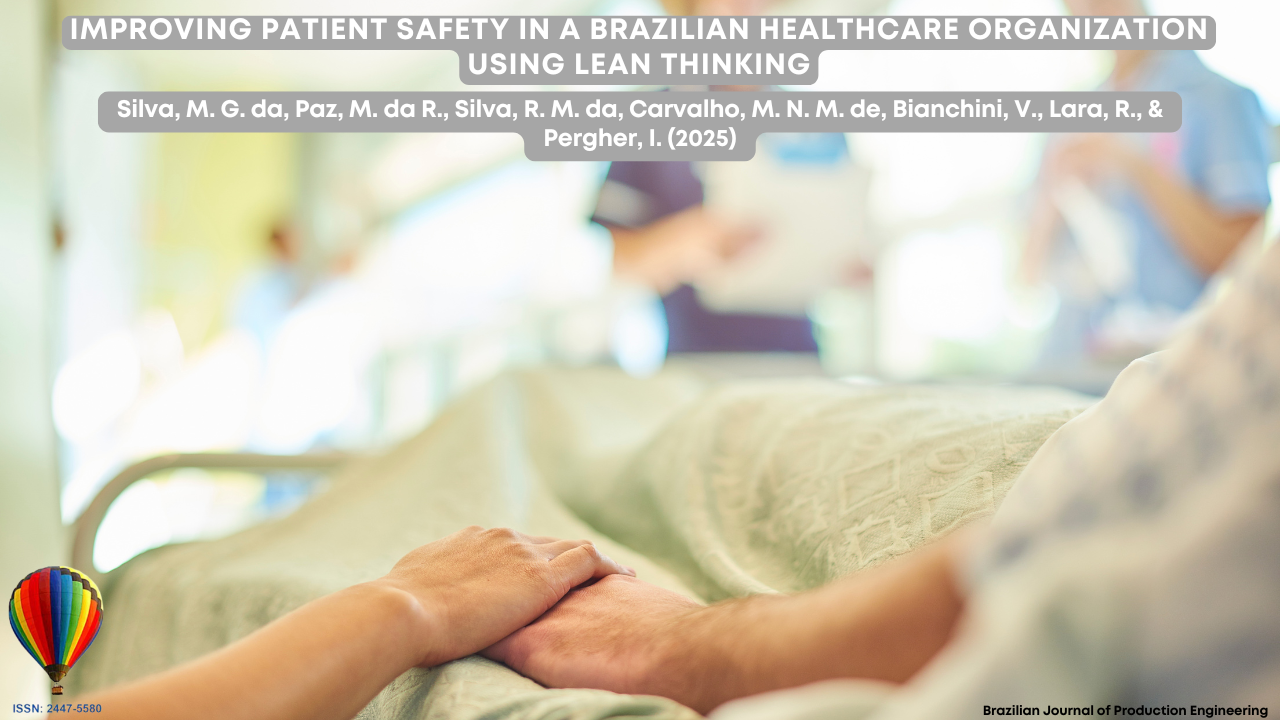
This paper aims to present the trajectory of a Brazilian healthcare organization in a Lean Healthcare (LH) project to enhance patient safety and integrate a culture of continuous improvement. The action research is about a unit dedicated to diagnostic imaging medicine to investigate and improve patient safety. Advances in mitigating inappropriate processing, patient waiting, and wastes due to movements of employees during the on-site exams were evident. The proposed changes directly impacted on reducing the risk of patient safety failures, enhanced patient identification, and makespan reduction by 30.37%. The article can motivate researchers and health managers to explore in depth the LH as a foundation for management decisions, especially in emerging countries. The paper illustrates that LH provides a practical framework for healthcare organizations to enhance patient safety, improve operational efficiency, and reduce waste through systematic process improvements and a culture of continuous learning. This research contributes by providing a real-world case of LH implementation in a challenging environment, detailing specific waste categories and mitigation strategies, and reinforcing the value of Lean principles for enhancing patient safety and operational efficiency in healthcare.
Downloads
References
Anselmo, R. B., Da Silva, M. G., Silva, R. M. da, & Bianchini, V. U. (2020). Avanço de desempenho produtivo com a implementação do trabalho padronizado em uma célula de manufatura. TECNO-LÓGICA, 24, 289–299. https://doi.org/10.17058/tecnolog.v2i0.15623
Augusto, B. P., & Tortorella, G. L. (2019). Literature review on lean healthcare implementation: Assessment methods and practices. International Journal of Services and Operations Management, 32(3), 285–306. https://doi.org/10.1504/IJSOM.2019.098351
Bopp, B. W., & Da Silva, M. G. (2017). Ações de melhoria em uma agência de marketing digital através do pensamento sistêmico: uma pesquisa-ação. Espacios, 38(44), 7. http://www.revistaespacios.com/a17v38n44/17384407.html
Borges, G. A., Tortorella, G., Rossini, M., & Portioli-Staudacher, A. (2019). Lean implementation in healthcare supply chain: a scoping review. Journal of Health Organization and Management, 33(3), 304–322. https://doi.org/10.1108/JHOM-06-2018-0176
Bortolotti, T., Boscari, S., & Danese, P. (2015). Successful lean implementation: Organizational culture and soft lean practices. International Journal of Production Economics, 160, 182–201. https://doi.org/10.1016/j.ijpe.2014.10.013
Camargo, A. de O., Da Silva, M. G., & Simões, W. L. (2018). Contribuições de um evento kaizen para a produção de painéis eletrônicos automotivos: um estudo de caso. Brazilian Journal of Production Engineering, 4(4), 24–43. http://www.periodicos.ufes.br/BJPE/article/view/V04N04_02
Costa, L. B. M., & Godinho Filho, M. (2016). Lean healthcare: review, classification and analysis of literature. Production Planning and Control, 27(10), 823–836. https://doi.org/10.1080/09537287.2016.1143131
Coughlan, P., & Coghlan, D. (2002). Action research for operations management. International Journal of Operations & Production Management, 22(2), 220–240. https://doi.org/10.1108/01443570210417515
Crema, M., & Verbano, C. (2019). Simulation modelling and lean management in healthcare: first evidences and research agenda. Total Quality Management & Business Excellence. https://doi.org/10.1080/14783363.2019.1572504
Da Cas, F., Da Silva, M. G., Luz, D. F. Da, & Pacheco, D. A. de J. (2015). Implicações da redução de setup na produtividade da indústria farmacêutica. Revista GEINTEC, 5(1), 1764–1779. https://doi.org/10.7198/S2237-0722201500010014
Da Silva, M. G. (2016). Jidoka: Conceitos e aplicação da autonomação em uma empresa da indústria eletrônica. Espacios, 37(2), 17. http://www.revistaespacios.com/a16v37n02/16370218.html
De Freitas, E. S., & Da Silva, M. G. (2017). Pesquisa-ação sobre a implementação do trabalho padronizado em uma célula de manufatura de uma fábrica de tratores. Espacios, 38(46), 21. https://www.revistaespacios.com/a17v38n46/17384621.html
Ferreira, R. S., & Da Silva, M. G. (2018). Lean office: uma aplicação no planejamento de ordens de manutenção. Revista de Iniciação Científica Da ULBRA, 16, 187–203. http://www.periodicos.ulbra.br/index.php/ic/article/view/4682
Fournier, P.-L., & Jobin, M. H. (2018). Understanding before implementing: the context of Lean in public healthcare organizations. Public Money & Management, 38(1), 37–44. https://doi.org/10.1080/09540962.2018.1389505
Henrique, D. B., Godinho Filho, M., Marodin, G., Jabbour, A. B. L. de S., & Chiappetta Jabbour, C. J. (2020). A framework to assess sustaining continuous improvement in lean healthcare. International Journal of Production Research. https://doi.org/10.1080/00207543.2020.1743892
Henrique, D. B., Rentes, A. F., Godinho Filho, M., & Esposto, K. F. (2016). A new value stream mapping approach for healthcare environments. Production Planning and Control, 27(1), 24–48. https://doi.org/10.1080/09537287.2015.1051159
Hicks, C., McGovern, T., Prior, G., & Smith, I. (2015). Applying lean principles to the design of healthcare facilities. International Journal of Production Economics, 170(Part. B), 677–686. https://doi.org/10.1016/j.ijpe.2015.05.029
Leite, H., Williams, S., Radnor, Z., & Bateman, N. (2024). Emergent barriers to the lean healthcare journey: baronies, tribalism and scepticism. Production Planning and Control. https://doi.org/10.1080/09537287.2022.2054386
Lindsay, C. F., & Aitken, J. (2024). Using Programme Theory to evaluate Lean interventions in healthcare. Production Planning and Control. https://doi.org/10.1080/09537287.2022.2139778
Lindsay, C. F., Kumar, M., & Juleff, L. (2020). Operationalising lean in healthcare: the impact of professionalism. Production Planning and Control, 31(8), 629–643. https://doi.org/10.1080/09537287.2019.1668577
Lopes, C. M., Scavarda, A. J., de Carvalho, M. N. M., & Korzenowski, A. L. (2019). The business model and innovation analyses: The sustainable transition obstacles and drivers for the hospital supply chains. Resources, 8(1), 3. https://doi.org/10.3390/resources8010003
Marciano, M. A., Vaccaro, G., & Scavarda, A. (2019). Quality of the public health system: A systemic comprehension in Brazilian southern region. Gestao e Producao, 26(1), e1626. https://doi.org/10.1590/0104-530X1626-19
Mendes, G. H. D. S., & Mirandola, T. B. D. S. (2015). Hospital accreditation as an improvement strategy: Impacts and difficulties in six accredited hospitals. Gestão & Produção, 22(3), 636–648. https://doi.org/10.1590/0104-530X1226-14
Resolução - RDC No 36, de 25 de Julho de 2013, (2013). https://bvsms.saude.gov.br/bvs/saudelegis/anvisa/2013/rdc0036_25_07_2013.html
Ministério da Saúde, B.-. (2014). Documento de referência para o Programa Nacional de Segurança do Paciente (M. da Saúde, F. O. Cruz, & A. N. de V. Sanitária (eds.); p. 40). Ministério da Saúde.
Sales Coll, M., De Castro, R., Ochoa de Echagüen, A., & Martínez Ibáñez, V. (2024). Economic Impact of Lean Healthcare Implementation on the Surgical Process. Healthcare (Switzerland). https://doi.org/10.3390/healthcare12050512
Santos, B. M., Fogliatto, F. S., Saurin, T. A., & Tortorella, G. L. (2024). Modeling help chains in health services as social networks: moving from linearity to complexity. International Journal of Production Research. https://doi.org/10.1080/00207543.2023.2298486
Saurin, T. A., & Gonzalez, S. S. (2013). Assessing the compatibility of the management of standardized procedures with the complexity of a sociotechnical system: Case study of a control room in an oil refinery. Applied Ergonomics, 44(5), 811–823. https://doi.org/10.1016/j.apergo.2013.02.003
Singh, P. (2019). Lean in healthcare organization: an opportunity for environmental sustainability. Benchmarking: An International Journal, 26(1), 205–220. https://doi.org/10.1108/BIJ-04-2018-0104
Siqueira, C. L., Siqueira, F. F., Lopes, G. C., Gonçalves, M. de C., & Sarantopoulos, A. (2019). Enteral diet therapy: use of the Lean Healthcare philosophy in process improvement. Revista Brasileira de Enfermagem, 72(1), 235–242. https://doi.org/10.1590/0034-7167-2017-0746
Slawomirski, L., Auraaen, A., & Klazinga, N. (2017). The economics of patient safety: Strengthening a value–base approach to reducing patient harm at national level (No. 96). https://doi.org/https://doi.org/10.1787/5a9858cd-en
Sunder M, V., Mahalingam, S., & Krishna M, S. N. (2020). Improving patients’ satisfaction in a mobile hospital using Lean Six Sigma – a design-thinking intervention. Production Planning and Control, 31(6), 512–526. https://doi.org/10.1080/09537287.2019.1654628
Tortorella, G., Augusto, B. P., França, S. L. B., & Sawhney, R. (2019). Assessment methodology for Lean Practices in healthcare organizations: Case study in a Brazilian public hospital. Production, 29. https://doi.org/10.1590/0103-6513.20180080
Toussaint, J. S., & Berry, L. L. (2013). The promise of lean in health care. Mayo Clinic Proceedings, 88(1), 74–82. https://doi.org/10.1016/j.mayocp.2012.07.025
WHO. (2007). World Health Organization - Patient safety solutions preamble. https://www.who.int/patientsafety/solutions/patientsafety/Preamble.pdf
WHO. (2020). World Health Organization - Patient safety. https://www.who.int/patientsafety/en/
Young, T. P., & McClean, S. I. (2008). A critical look at Lean Thinking in healthcare. BMJ Quality and Safety, 17, 382-386. https://doi.org/10.1136/qshc.2006.020131
Downloads
Published
Issue
Section
License
Copyright (c) 2025 Da Silva, M. G., Paz, M. da R., Silva, R. M. da, Carvalho, M. N. M. de, Bianchini, V., Lara, R., & Pergher, I.

This work is licensed under a Creative Commons Attribution 4.0 International License.

All works published in the Brazilian Journal of Production Engineering (BJPE) are licensed under Creative Commons Attribution 4.0 International (CC BY 4.0).
This means that:
Anyone can copy, distribute, display, adapt, remix, and even commercially use the content published in the journal;
Provided that due credit is given to the authors and to BJPE as the original source;
No additional permission is required for reuse, as long as the license terms are respected.
This policy complies with the principles of open access, promoting the broad dissemination of scientific knowledge.


2.png)