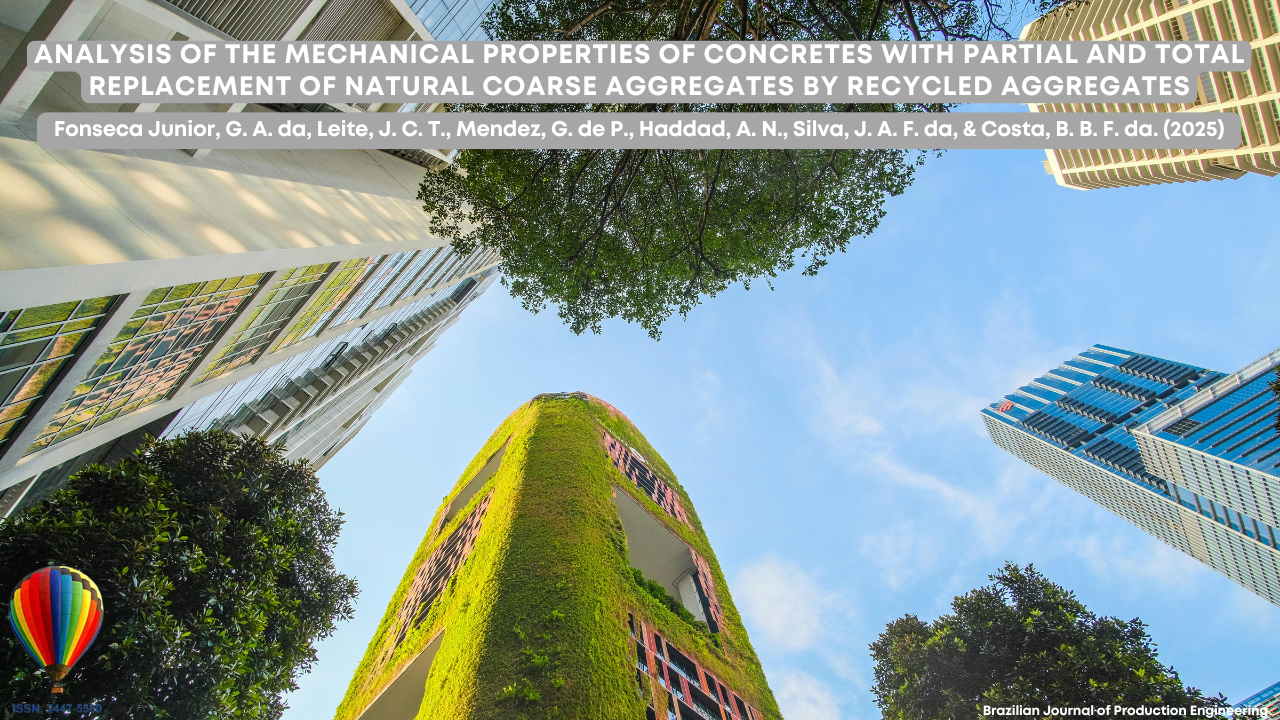
Analysis of the mechanical properties of concretes with partial and total replacement of natural coarse aggregates by recycled aggregates
DOI:
https://doi.org/10.47456/bjpe.v11i4.50157Keywords:
recycled concrete, coarse aggregate, sustainabilityAbstract
Given the increase in global concrete consumption, environmental impacts have also intensified, requiring the construction sector to develop concrete production in line with the Sustainable Development Goals (SDGs). In this context, the use of Construction and Demolition Waste (CDW) as a replacement for natural aggregates emerges as an alternative. Therefore, the objective of this study was to analyze the compressive and tensile strength of concrete produced with recycled aggregate in comparison to reference concrete, through an experimental program using recycled concrete coarse aggregates with maximum diameters of 9.5 mm and 19 mm. For each granulometry, concrete mixtures were produced with natural aggregate replacement ratios of 0%, 30%, 50%, and 100%. Strength tests revealed that the target compressive strength of 25 MPa was achieved by all mixtures, while tensile strength reached between 8% and 12% of compressive test values. The ANOVA statistical method verified that all studied mixtures presented statistically equal mean strengths at 28 days. These results demonstrate that recycled aggregate concrete can be a promising material for the construction sector, while also contributing to SDG 12: Responsible Consumption and Production.
Downloads
References
Aver, G., Miri, D. H., Chais, C., Matte, J., Ganzer, P. P., & Olea, P. M. (2020). Fatores de rotatividade em uma empresa do segmento metalomecânico: Rotativity factors in a mechanical metal segment company. Revista Visão: Gestão Organizacional, 9(2), 168-186.
Breiman, L. (2001). Random forests. Machine learning, 45(1), 5-32.
Chiavenato, I. (2014). Gestão de Pessoas: O Novo Papel dos Recursos Humanos nas Organizações. 4 ed. Elsevier Brasil.
Cramér, H. (1999). Mathematical methods of statistics (Vol. 9). Princeton university press.
Dutra, J. S. (2016). Gestão de pessoas: modelo, processos, tendências e perspectivas. 3 ed. Atlas.
Elmasri, R., Navathe, S. B., & Pinheiro, M. G. (2005). Sistemas de banco de dados.
Fávero, L. P., & Belfiore, P. (2024). Manual de análise de dados: Estatística e machine learning com Excel®, SPSS®, Stata®, R® e Python®. GEN, LTC.
Hair, J. F. (2009). Multivariate data analysis.
Han, J., Kamber, M., & Pei, J. (2020). Data mining: Concepts and. Techniques, Waltham: Morgan Kaufmann Publishers.
Hastie, T. (2009). The elements of statistical learning: data mining, inference, and prediction.
Hom, P. W., Lee, T. W., Shaw, J. D., & Hausknecht, J. P. (2017). One hundred years of employee turnover theory and research. Journal of applied psychology, 102(3), 530.
Hosmer Jr, D. W., Lemeshow, S., & Sturdivant, R. X. (2013). Applied logistic regression. John Wiley & Sons.
James, G. (2013). An introduction to statistical learning with applications in R.
Pedregosa, F., Varoquaux, G., Gramfort, A., Michel, V., Thirion, B., Grisel, O., Blondel, M., Prettenhofer, P., Weiss, R., Dubourg, V., Vanderplas, J., Passos, A., Cournapeau, D., Brucher, M., Perrot, M., & Duchesnay, É. (2011). Scikit-learn: Machine learning in Python. Journal of Machine Learning Research. 12, 2825-2830.
Samuel, F. (2024). Retention Strategies for Project-Based Construction Workers: The Role of Career-Family Balance Initiatives.
Spearman, C. (1961). "General Intelligence" Objectively Determined and Measured.
Published
Issue
Section
License
Copyright (c) 2025 Fonseca Junior, G. A. da, Leite, J. C. T., Mendez, G. de P., Haddad, A. N., Silva, J. A. F. da, & Costa, B. B. F. da.

This work is licensed under a Creative Commons Attribution 4.0 International License.

All works published in the Brazilian Journal of Production Engineering (BJPE) are licensed under Creative Commons Attribution 4.0 International (CC BY 4.0).
This means that:
Anyone can copy, distribute, display, adapt, remix, and even commercially use the content published in the journal;
Provided that due credit is given to the authors and to BJPE as the original source;
No additional permission is required for reuse, as long as the license terms are respected.
This policy complies with the principles of open access, promoting the broad dissemination of scientific knowledge.


2.png)