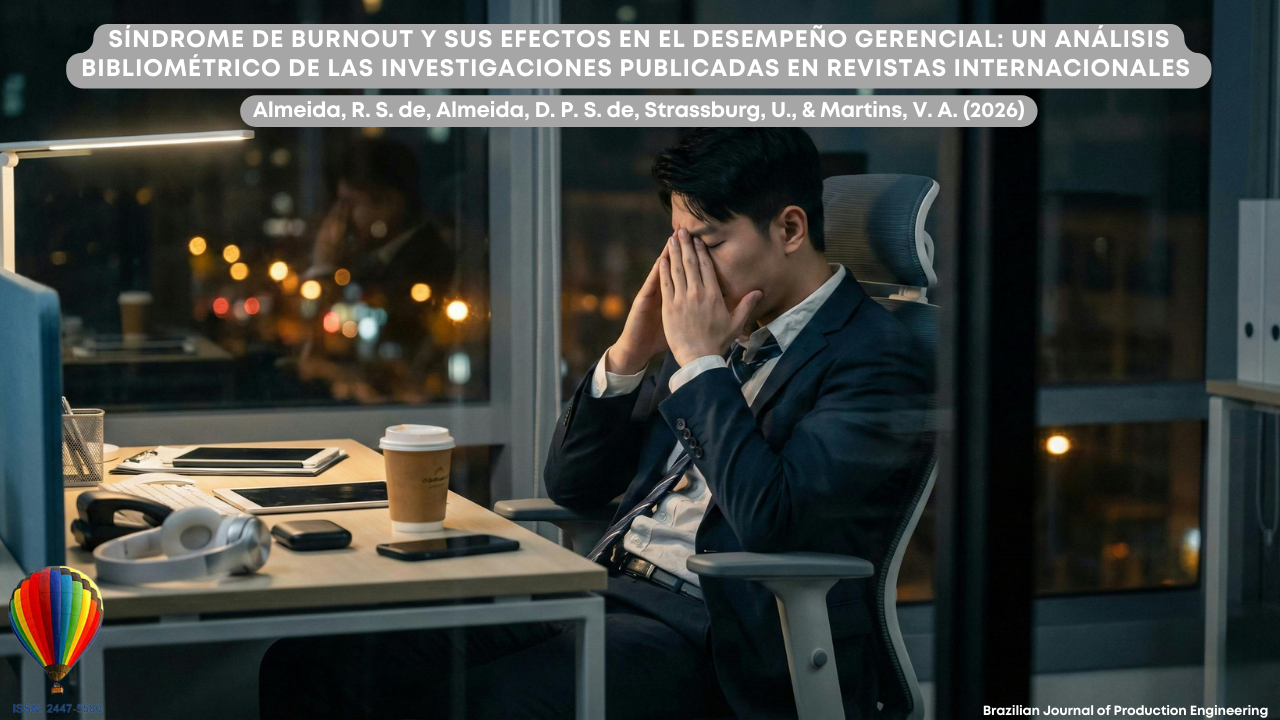
Síndrome de Burnout y sus efectos en el desempeño gerencial: un análisis bibliométrico de las investigaciones publicadas en revistas internacionales
DOI:
https://doi.org/10.47456/bjpe.v12i1.50378Palabras clave:
bibliometría, Burnout, Desempeño, Ley de Bradford, Ley de ZipfResumen
Al realizar una investigación, comprender el estado del arte es esencial, ya que permite identificar la evolución de un tema dado y apoya la selección de literatura científica relevante. Por ello, este estudio pretende analizar el estado del arte de la investigación que investiga el impacto del síndrome de agotamiento en el rendimiento de la gestión. La bibliometría fue adoptada como enfoque metodológico, ya que se basa en técnicas matemáticas y estadísticas aplicadas al análisis de publicaciones científicas. Este estudio se caracteriza por ser descriptivo, bibliográfico y cuantitativo. La recopilación de datos se llevó a cabo utilizando el Proceso de Desarrollo del Conocimiento – Constructivista (ProKnow-C), lo que resultó en un portafolio bibliográfico compuesto por 45 artículos científicos internacionales. El análisis de datos se basó en la Ley de Bradford, para evaluar la relevancia en revistas, y en la Ley de Zipf, para examinar la frecuencia de palabras clave. Los resultados revelan un aumento significativo en las publicaciones en los últimos dos años, representando el 27% del total de estudios analizados, así como una concentración de publicaciones en revistas como el Journal of Organizational Behavior y el Journal of Applied Psychology. Los resultados indican un creciente interés académico en la relación entre el síndrome de agotamiento y el rendimiento gerencial en el contexto organizacional.
Descargas
Referencias
Avey, J. B., Reichard, R. J., Luthans, F., & Mhatre, K. H. (2011). Meta‐analysis of the impact of positive psychological capital on employee attitudes, behaviors, and performance. Human Resource Development Quarterly, 22(2), 127-152.
Benevides-Pereira, A. M. T. (2012). Considerações sobre a síndrome de burnout e seu impacto no ensino. Boletim de Psicologia, 62(137), 155-168.
Byrne, Z. S., & Hochwarter, W. A. (2008). Perceived organizational support and performance. Journal of Managerial Psychology, 23(1), 54-72. 10.1108/02683940810849666
Byrne, Z. S., & Hochwarter, W. A. (2008). Perceived organizational support and performance: relationships across levels of organizational cynicism. Journal of Managerial Psychology, 23(1), 54-72.
Carlotto, M. S. (2011). Síndrome de Burnout em Professores: Prevalência e Fatores Associados. Psicologia em Estudo, 16(2), 213-220. https://doi.org/10.1590/S0102-37722011000400003
Carlotto, M. S. & Câmara, S. G. (2006). Características psicométricas do Maslach Burnout Inventory-Student Survey (MBI-SS) em estudantes universitários brasileiros. Psico-USF, 11(2), 167-73. Recuperado de http://pepsic.bvsalud.org/scielo.php?script=sci_arttext&pid=S1413-82712006000200005
Carlotto, M. S. & Palazzo, L. D. S. (2006). Síndrome de burnout e fatores associados: um estudo epidemiológico com professores. Cadernos de Saúde Pública, 22, 1017-1026. https://doi.org/10.1590/S0102-311X2006000500014
Carlotto, M. S. & Palazzo, L. D. S. (2006). Síndrome de burnout e fatores associados: um estudo epidemiológico com professores. Cadernos de Saúde Pública, 22, 1017-1026. Recuperado de https://www.scielosp.org/article/csp/2006.v22n5/1017-1026/pt/
Corbeanu, A., Iliescu, D., Ion, A., & Spînu, R. (2023). The link between burnout and job performance: a meta-analysis. European Journal of Work and Organizational Psychology, 1-18.
Costa, E. F. D. O., Santos, S. A., Santos, A. T. R. D. A., Melo, E. V. D., & Andrade, T. M. D. (2012). Burnout Syndrome and associated factors among medical students: a cross-sectional study. Clinics, 67(6), 573-580. Recuperado de https://www.scielo.br/scielo.php?script=sci_arttext&pid=S1807-59322012000600005
Costa, E. F. D. O., Santos, S. A., Santos, A. T. R. D. A., Melo, E. V. D., & Andrade, T. M. D. (2012). Burnout Syndrome and associated factors among medical students: a cross-sectional study. Clinics, 67(6), 573-580. Recuperado de https://www.scielo.br/scielo.php?script=sci_arttext&pid=S1807-59
Dornelles, J. G. F., Souza, R. B. de L. de, & Pain, P. (2023). Pesquisa em contabilidade sobre Blockchain: olhando pelas Leis de Bradford, Lotka e Zipf. ConTexto - Contabilidade em Texto, 23(53), 2-20. Recuperado de https://seer.ufrgs.br/index.php/ConTexto/article/view/120283
Freudenberger, H. J. (1974). Staff burn‐out. Journal of Social Issues, 30(1), 159-165. Recuperado de https://spssi.onlinelibrary.wiley.com/doi/abs/10.1111/j.1540-4560.1974.tb00706.x
George, L., Wallace, J. C., Snider, J. B., & Suh, H. (2023). Self-Compassion, performance, and Burnout: surfacing an unknown work construct. Group & Organization Management, 10596011231161123.
Goodwin, R. E., Groth, M., & Frenkel, S. J. (2011). Relationships between emotional labor, job performance, and turnover. Journal of Vocational Behavior, 79(2), 538-548.
Goodwin, R. E., Groth, M., & Frenkel, S. J. (2011). Relationships between emotional labor, job performance, and turnover. Journal of Vocational Behavior, 79(2), 538-548.
Guedes, V. L. & Borschiver, S. (2005). Bibliometria: uma ferramenta estatística para a gestão da informação e do conhecimento, em sistemas de informação, de comunicação e de avaliação científica e tecnológica. Encontro Nacional de Ciência da Informação, 6(1), 18.
Gupta, V. & Kumar, S. (2012). Impact of performance appraisal justice on employee engagement: a study of Indian professionals. Employee relations, 35(1), 61-78.
Halbesleben, J. R. & Bowler, W. M. (2007). Emotional exhaustion and job performance: the mediating role of motivation. Journal of Applied Psychology, 92(1), 93.
Halbesleben, J. R., & Bowler, W. M. (2007). Emotional exhaustion and job performance: the mediating role of motivation. Journal of Applied Psychology, 92(1), 93. Reucperado de https://doi.org/10.1037/0021-9010.92.1.93
Halbesleben, J. R. & Wheeler, A. R. (2011). I owe you one: coworker reciprocity as a moderator of the day‐level exhaustion–performance relationship. Journal of Organizational Behavior, 32(4), 608-626.
Hoon Song, J., Kolb, J. A., Hee Lee, U., & Kyoung Kim, H. (2012). Role of transformational leadership in effective organizational knowledge creation practices: mediating effects of employees' work engagement. Human Resource Development Quarterly, 23(1), 65-101.
Karatepe, O. M. (2013). The effects of work overload and work‐family conflict on job embeddedness and job performance: the mediation of emotional exhaustion. International Journal of Contemporary Hospitality Management, 25(4), 614-634.
Kotorri Dushi, A. (2023). Transnational business services, cultural transformation/identity, and employee performance: with special focus on migration experience and emigration plan. Open Cultural Studies, 7(1), 20220168.
Kroon, B., Van de Voorde, K., & Van Veldhoven, M. J. P. M. (2009). Cross‐level effects of high‐performance work practices on burnout: two counteracting mediating mechanisms compared. Personnel Review, 38(5), 509-525.
Kurian, R. M. & Thomas, S. (2022). Importance of positive emotions in software developers’ performance: a narrative review. Theoretical Issues in Ergonomics Science, 1-15.
Lackritz, J. R. (2004). Exploring burnout among university faculty: Incidence, performance, and demographic issues. Teaching and Teacher Education, 20(7), 713-729.
LePine, J. A., LePine, M. A., & Jackson, C. L. (2004). Challenge and hindrance stress: relationships with exhaustion, motivation to learn, and learning performance. Journal of Applied Psychology, 89(5), 883.
Lynch, P. D., Eisenberger, R., & Armeli, S. (1999). Perceived organizational support: Inferior versus superior performance by wary employees. Journal of applied psychology, 84(4), 467.
Mahoney, T. A., Jerdee, T. H., & Carroll, S. J. (1963). Development of managerial performance: a research approach: South.
Martínez, I. M. M. & Pinto, A. M. (2005). Burnout en estudiantes universitarios de España y Portugal y su relación con variables académicas. Aletheia, (21), 21-30. Recuperado de http://pepsic.bvsalud.org/scielo.php?script=sci_arttext&pid=S1413-03942005000100003
Maslach, C., Jackson, S. E., Leiter, M. P., Schaufeli, W. B., & Schwab, R. L. (1986). Maslach burnout inventory (vol. 21, pp. 3463-3464). Palo Alto, CA: Consulting Psychologists Press.
Maslach, C., Schaufeli, W. B., & Leiter, M. P. (2001). Job burnout. Annual Review of Psychology, 52(1), 397-422. Recuperado de https://www.annualreviews.org/doi/abs/10.1146/annurev.psych.52.1.397
Maslach, C., Schaufeli, W. B., & Leiter, M. P. (2001). Job burnout. Annual review of psychology, 52(1), 397-422. Recuperado de https://www.annualreviews.org/doi/abs/10.1146/annurev.psych.52.1.397
Mousa, M. E. S. & Kamel, M. A. (2022). Organizational performance assessment based on psychological empowerment and employee engagement: PCA-DEA-SEM approach. Journal of Modelling in Management.
Naqshbandi, M. M., Kabir, I., Ishak, N. A., & Islam, M. Z. (2023). The future of work: work engagement and job performance in the hybrid workplace. The Learning Organization.
Neves, P., Mesdaghinia, S., Eisenberger, R., & Wickham, R. E. (2018). Timesizing proximity and perceived organizational support: Contributions to employee well-being and extra-role performance. Journal of Change Management, 18(1), 70-90.
Oliveira, B. D. & Benetti, J. E. (2016). Importância do profissional da contabilidade na gestão de micro e pequenas empresas localizadas em Chapecó/SC. Revista Tecnológica, 5(2), 178-196. Recuperado de https://uceff.edu.br/revista/index.php/revista/article/view/158
Oliveira, R. M. & Beuren, I. M. (2020). Sobrecarga e estresse no trabalho durante a pandemia de Covid-19: Influência no desenvolvimento de Burnout em profissionais contábeis. In USP International Conference Iin Accounting (20).
Page M J, Moher D, Bossuyt P M, Boutron I, Hoffmann T C, Mulrow C D et al. (2021). PRISMA 2020 explanation and elaboration: updated guidance and exemplars for reporting systematic reviews BMJ. 372 https://doi.org/10.1136/bmj.n160
Penney, L. M., David, E., & Witt, L. A. (2011). A review of personality and performance: Identifying boundaries, contingencies, and future research directions. Human Resource Management Review, 21(4), 297-310.
Pereira, A. M. T. B. (2002). Burnout: quando o trabalho ameaça o bem. Casa do psicólogo.
Petrou, P., Demerouti, E., Peeters, M. C., Schaufeli, W. B., & Hetland, J. (2012). Crafting a job on a daily basis: contextual correlates and the link to work engagement. Journal of Organizational Behavior, 33(8), 1120-1141.
Pinheiro, L. V. R. (1983). Lei de Bradford: uma reformulação conceitual.
Reed, B. N., Lebovitz, L., & Layson-Wolf, C. (2023). How resilience and wellness behaviors affected burnout and academic performance of first-year pharmacy students during Covid-19. American Journal of Pharmaceutical Education, 87(2).
RJ Singh, S., Sharma, K. K., Mittal, A., & Chand, P. K. (2022). Effect of motivating language on employee performance: mediating role of organizational citizenship behavior and employee engagement in the healthcare sector. Global Knowledge, Memory and Communication.
Rodríguez, M. C., Hinojosa, L. M. M., & Ramírez, M. T. G. (2014). Evaluación del desempeño docente, estrés y burnout en profesores universitarios/Evaluation of teacher performance, stress and burnout in university professors. Actualidades Investigativas en Educación, 14(1). Recuperado de https://www.redalyc.org/pdf/447/44729876006.pdf
Salanova, M., Agut, S., & Peiró, J. M. (2005). Linking organizational resources and work engagement to employee performance and customer loyalty: the mediation of service climate. Journal of applied Psychology, 90(6), 1217.
Sampieri, R. H., Collado, C. F., & Lucio, M.D.P. B. (2013). Metodologia de pesquisa (5th ed.). Grupo A. Recuperado em https://integrada.minhabiblioteca.com.br/books/9788565848367
Santos Matos, L. & Petri, S. M. (2015). Balanced Scorecard na gestão universitária: mapeamento sobre o tema utilizando o Proknow-C. Revista Gestão Universitária na América Latina-GUAL, 8(2), 50-69.
Schaufeli, W. B., Martinez, I. M., Pinto, A. M., Salanova, M., & Bakker, A. B. (2002). Burnout and engagement in university students: a cross-national study. Journal of Cross-Cultural Psychology, 33(5), 464-481. Recuperado de https://www.isonderhouden.nl/doc/pdf/arnoldbakker/articles/articles_arnold_bakker_78.pdf
Schermerhorn Jr., J. R., Hunt, J. G., & Osborn, R. N. (2009). Fundamentos de comportamento organizacional. Bookman Editora
Sharma, J. & Dhar, R. L. (2016). Factors influencing job performance of nursing staff: mediating role of affective commitment. Personnel Review, 45(1), 161-182.
Shim, M. (2010). Factors influencing child welfare employee's turnover: focusing on organizational culture and climate. Children and Youth Services Review, 32(6), 847-856.
Shin, Y. & Hur, W. M. (2021). When do job-insecure employees keep performing well? The buffering roles of help and prosocial motivation in the relationship between job insecurity, work engagement and job performance. Journal of Business and Psychology, 36, 659-678.
Shuck, B., Twyford, D., Reio Jr, T. G., & Shuck, A. (2014). Human resource development practices and employee engagement: examining the connection with employee turnover intentions. Human Resource Development Quarterly, 25(2), 239-270.
Simmons, B. L., Gooty, J., Nelson, D. L., & Little, L. M. (2009). Secure attachment: Implications for hope, trust, burnout, and performance. Journal of Organizational Behavior: The International Journal of Industrial, Occupational and Organizational Psychology and Behavior, 30(2), 233-247.
Sliter, M., Sliter, K., & Jex, S. (2012). The employee as a punching bag: the effect of multiple sources of incivility on employee withdrawal behavior and sales performance. Journal of Organizational Behavior, 33(1), 121-139.
Stempel, C. R., Biemelt, J., & Dettmers, J. (2022). Never off duty-the role of supervisors in the relationship between extended availability, subordinate strain, and job performance. MREV Management Revue, 33(1), 42-58.
Tang, P., Zhang, X., Feng, F., Li, J., Zeng, L., Xie, W., ..., & Wang, J. (2022). The relationship between organizational commitment and work engagement among clinical nurses in China: a cross‐sectional study. Journal of Nursing Management, 30(8), 4354-4363.
Taris, T. W. (2006). Is there a relationship between burnout and objective performance? A critical review of 16 studies. Work & Stress, 20(4), 316-334.
Taris, T. W., & Schreurs, P. J. (2009). Well-being and organizational performance: An organizational-level test of the happy-productive worker hypothesis. Work & Stress, 23(2), 120-136.
Tasca. E, J., Ensslin, L., Rolim Ensslin, S., & Bernardete Martins Alves, M. (2010). An approach for selecting a theoretical framework for the evaluation of training programs. Journal of European Industrial Training, 34(7), 631-655. 10.1108/03090591011070761
Thomas, C. H. & Lankau, M. J. (2009). Preventing burnout: The effects of LMX and mentoring on socialization, role stress, and burnout. Human resource management: published in Cooperation with the School of Business Administration. The University of Michigan and in alliance with the Society of Human Resources Management, 48(3), 417-432.
Tims, M., Bakker, A. B., & Derks, D. (2015). Job crafting and job performance: a longitudinal study. European Journal of Work and Organizational Psychology, 24(6), 914-928.
Van De Voorde, K. & Beijer, S. (2015). The role of employee HR attributions in the relationship between high‐performance work systems and employee outcomes. Human Resource Management Journal, 25(1), 62-78.
Van den Bosch, R. & Taris, T. W. (2014). The authentic worker's well-being and performance: the relationship between authenticity at work, well-being, and work outcomes. The Journal of Psychology, 148(6), 659-681.
Van Gelderen, B. R., Konijn, E. A., & Bakker, A. B. (2017). Emotional labor among police officers: a diary study relating strain, emotional labor, and service performance. The International Journal of Human Resource Management, 28(6), 852-879.
Waqar, H., Mahmood, A., & Ali, M. (2023). High-performance work systems and coping strategies in regulating burnout and safety workarounds in the healthcare sector. SAGE Open Nursing, 9, 23779608231162058.
Xu, E., Huang, X., Lam, C. K., & Miao, Q. (2012). Abusive supervision and work behaviors: The mediating role of LMX. Journal of Organizational Behavior, 33(4), 531-543.
Zhang, G., Peng, K., & Chen, S. (2023). The double‐edged sword effect of high‐performance work systems: investigating when and why high‐performance work systems promote versus inhibit employee organizational citizenship behaviors. Asia Pacific Journal of Human Resources, 61(1), 168-195.
Zia, M. Q., Decius, J., Naveed, M., Ahmed, S., & Ghauri, S. (2023). Committed, healthy, and engaged? Linking servant leadership and adaptive performance through sequential mediation by job embeddedness and burnout. Journal of Leadership & Organizational Studies, 15480518231158861.
Zimmerman, R. D. (2008). Understanding the impact of personality traits on individuals ‘turnover decisions: a meta‐analytic path model. Personnel Psychology, 61(2), 309-348.
Zonatto, V. D. S. (2014). Influência de fatores sociais cognitivos de capacidade, vontade e oportunidade sobre o desempenho gerencial nas atividades orçamentárias das maiores empresas exportadoras do Brasil. Tese - Universidade Regional de Blumenau, Programa de Pós-Graduação em Ciências Contábeis e Administração, Blumenau. Recuperado de http://bu.furb.br/docs/TE/2014/358328_1_1.pdf
Publicado
Número
Sección
Licencia
Derechos de autor 2026 Almeida, R. S. de, Almeida, D. P. S. de, Strassburg, U., & Martins, V. A.

Esta obra está bajo una licencia internacional Creative Commons Atribución 4.0.

Todas las obras publicadas en la Revista Brasileña de Ingeniería de Producción (BJPE) están bajo la licencia Creative Commons Atribución 4.0 Internacional (CC BY 4.0).
Esto significa que:
Cualquier persona puede copiar, distribuir, exhibir, adaptar, remezclar e incluso utilizar comercialmente el contenido publicado en la revista;
Siempre que se reconozca debidamente a los autores y a BJPE como fuente original;
No se requiere permiso adicional para la reutilización, siempre que se respeten los términos de la licencia.
Esta política cumple con los principios de acceso abierto, promoviendo la amplia difusión del conocimiento científico.


2.png)