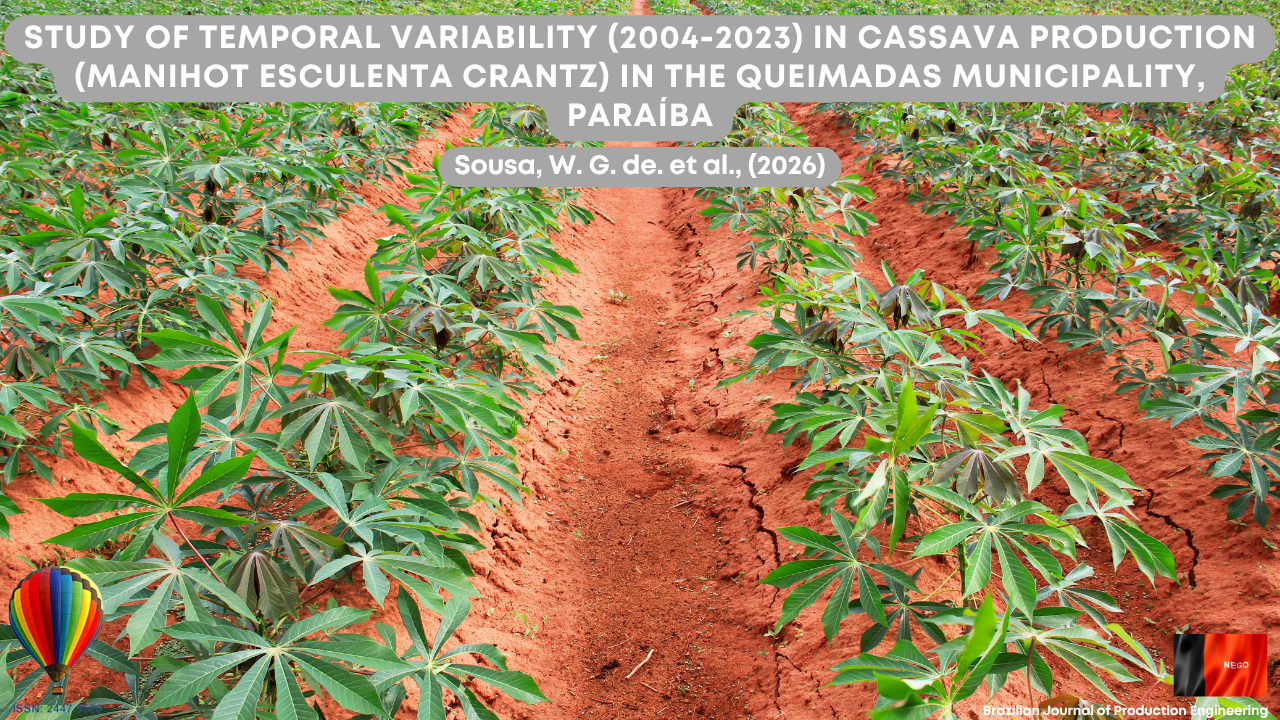
Study of temporal variability (2004-2023) in cassava production (Manihot esculenta Crantz) in the Queimadas municipality, Paraíba
DOI:
https://doi.org/10.47456/bjpe.v12i1.50275Keywords:
Roots, Factors, EnhanceAbstract
Cassava is a crop of socioeconomic and environmental importance in Brazil, especially in the Northeast region. Its roots are rich in starch, used in human and animal nutrition, and as a raw material in industry. Factors such as the use of low-yield genetic materials, inadequate soil management practices, and the occurrence of pests and diseases compromise the crop. Therefore, the objective of this study was to analyze the production performance of cassava in Queimadas, Paraíba, from 2004 to 2023. The aim was to identify factors that influenced the evolution of local production, to determine which aspects determined the variations in cassava production, and how this can guide strategies and public policies for the sustainable strengthening of the crop. The analysis of the temporal variability of production showed that there was no significant progress, indicating the need for attention to the factors that influence the crop's productivity and profitability, reinforcing the urgent need to adopt new management techniques. Investments in producer training, genetic improvement, appropriate soil management, and rational use of irrigation are alternatives. Furthermore, encouraging agro-industrialization and the use of by-products is also promising for adding value and strengthening the local economy, making the activity more sustainable and competitive.
Downloads
References
Arigor, A., Asuquo, I., Anyiam, M., Godspower, K., & Arigor, A. (2023). Economic analysis of cassava value chain products in etche local government area, Rivers State, Nigeria. International Journal of Business and Applied Economics, 2(3). https://doi.org/10.55927/ijbae.v2i3.2476
Agbaeze, E. K., Ohunyeye, F. O., Obamen, J., & Ibe, G. I. (2020). Management of food crop for national development: problems and challenges of cassava processing in Nigeria. SAGE Open, 10(2), 2158244020919778. https://doi.org/10.1177/2158244020919778
Brito, R. S., Brito, R. S., Moreira, J. G. V., & Oliveira, A. V. (2019). Produtividade de mandioca na região do Vale do Juruá, Amazônia Ocidental. Scientia Naturalis, 1(1), Artigo 1. https://periodicos.ufac.br/index.php/SciNat/article/view/1929
FAO. Food and Agriculture Organization. (2020). FAOSTAT: crops and livestock products. https://www.fao.org/faostat/en/#data/QCL
Guimarães, D. L. F., Silva, R. N., Andrade, H. M. L. S., & Andrade, L. P. (2022). Cadeia produtiva da mandioca no território brasileiro inovações e tecnologias uma revisão sistemática da literatura: Uma revisão sistemática da literatura. Diversitas Journal, 7(1). https://doi.org/10.48017/dj.v7i1.2009
IBGE. Instituto Brasileiro de Geografia Estatística. (2017). Censo Agropecuário 2017 [Dataset]. https://cidades.ibge.gov.br/brasil/pb/pesquisa/24/76693
IBGE. Instituto Brasileiro de Geografia e Estatística. (2024). Censo 2024. https://cidades.ibge.gov.br/brasil/pb/Queimadas/panorama.
IBGE. Instituto Brasileiro de Geografia e Estatística. (2023). Produção Agropecuária 2023. https://www.ibge.gov.br/explica/producao-agropecuaria/coco-da-baia/br
Ponce, T. P., Ribeiro, M. R., & Telles, T. S. (2020). Dinâmica espacial da produção de mandioca no Paraná, Brasil. Confins. Revue franco-brésilienne de géographie, 48. https://doi.org/10.4000/confins.34307
Fontalvo, R. H. M. & Miranda, P. E. (2020). Comportamiento del consumidor frente a productos derivados de la yuca. Innovar, 30(75), 9-18. https://doi.org/10.15446/innovar.v30n75.83235
Rusdi, N., Singgih, B., Ulinuhayani, M., Nurhidayat, S. P., Triono, B., Soedarjo, M., & Widodo, Y. (2025). Enhancing cassava productivity for sustainable agriculture: the role of pruning optimization and plantix preview technology in tuber and starch yield. Journal of Advanced Research in Applied Sciences and Engineering Technology, 63(1), 73-86. https://doi.org/10.37934/araset.63.1.7386
Silva, R. B., Santos Neto, A. L., Santos, W. M., Teodoro, I., Barros, A. C., Santos, V. R., Souza, A. A., Martins, G. M. C., Costa, B. R. S., Souza, J. W. G., & Silva, D. M. R. (2025). Cassava growth and productive performance at different planting times in the agreste of Alagoas, northeastern Brazil. Revista Brasileira de Engenharia Agrícola e Ambiental, 29, e285686. https://doi.org/10.1590/1807-1929/agriambi.v29n6e285686
Lessa, L. S., Ledo, C. A. S., & Santos, V. S. (2017). Seleção de genótipos de mandioca com índices não paramétricos. Revista Raízes e Amidos Tropicais, 13(1), 1-17.
Lima, C. A., Montenegro, A. A. A., Santos, T. E. M., Andrade, E. M., & Monteiro, A. L. N. (2015). Práticas agrícolas no cultivo da mandioca e suas relações com o escoamento superficial, perdas de solo e água. Revista Ciência Agronômica, 46(4), 697-706.
Fukuda, W. M. G. & Silva, S. O. (2018). A cultura da mandioca no Brasil: avanços tecnológicos e perspectivas. Embrapa Mandioca e Fruticultura.
Hair, J. F., Black, W. C., Babin, B. J., & Anderson, R. E. (2019). Multivariate data analysis (8th ed.). Cengage Learning.
Jolliffe, I. T. & Cadima, J. (2016). Principal component analysis: a review and recent developments. Philosophical Transactions of the Royal Society A, 374(2065), 20150202. https://doi.org/10.1098/rsta.2015.0202
Menezes, R. S. C., Souza, A. P., & Silva, T. O. (2020). Análise da produtividade da mandioca em sistemas familiares do semiárido. Revista Agroecossistemas, 12(2), 103-112.
Oliveira, R. F., Santos, T. S., & Cardoso, D. A. (2022). Avaliação de produtividade da mandioca em função de práticas agroecológicas. Revista de Agricultura Familiar e Sustentabilidade, 10(1), 87-96.
Paula, M. T. (2024). Aspectos socioeconômicos e agronômicos da cultura da mandioca (Manihot esculenta Crantz): uma revisão de literatura. Brazilian Journal of Animal and Environmental Research, 7(3), 1-9.
Pinheiro, W. L., Maia, G. D. S., Almeida, F., Silva, R. D. C., Cruz, J. D., & Souza, R. M. (2021). Características agronômicas e produção da mandioca (Manihot esculenta Crantz cv. BRS-Poti) submetida a tratos culturais. Brazilian Journal of Development, 7(2), 18314-18325.
R CORE TEAM. (2023). R: A language and environment forstatistical computing. (2023). R Foundation for Statistical Computing, Vienna, Austria. https://www.R-project.org/.
SIDRA. Sistema IBGE de Recuperação Automática. (2025). Produção agrícola municipal. https://sidra.ibge.gov.br/pesquisa/pam/tabelas
Santos, M. E. S., Almeida, C. D. G. C., & Ferreira, E. M. (2023). Melhoramento genético da mandioca para sistemas de baixa entrada no semiárido. Cadernos de Agroecologia, 18(1), e2534.
Published
Issue
Section
License
Copyright (c) 2026 Sousa, W. G. de, Maddalena, A., Lima, S. L. de, Lima, R. da C. C., Alves, L. F., Araujo Neto, A. P. de, Barbosa , M. D. G. ., Isidro, R., Abreu, K. G., Gouveia, T. C. de M. ., Pontes, G. P. de, Albuquerque Júnior, A. M. de, Muniz, J. I. de A. S., Santos, R. V. ., Andrade, S. K. S. ., Sousa, F. de A. R. da M., Velez, E. da S. ., Silva, M. . da, Nobrega, H. F. S. ., … Silva, L. A. da.

This work is licensed under a Creative Commons Attribution 4.0 International License.

All works published in the Brazilian Journal of Production Engineering (BJPE) are licensed under Creative Commons Attribution 4.0 International (CC BY 4.0).
This means that:
Anyone can copy, distribute, display, adapt, remix, and even commercially use the content published in the journal;
Provided that due credit is given to the authors and to BJPE as the original source;
No additional permission is required for reuse, as long as the license terms are respected.
This policy complies with the principles of open access, promoting the broad dissemination of scientific knowledge.


2.png)