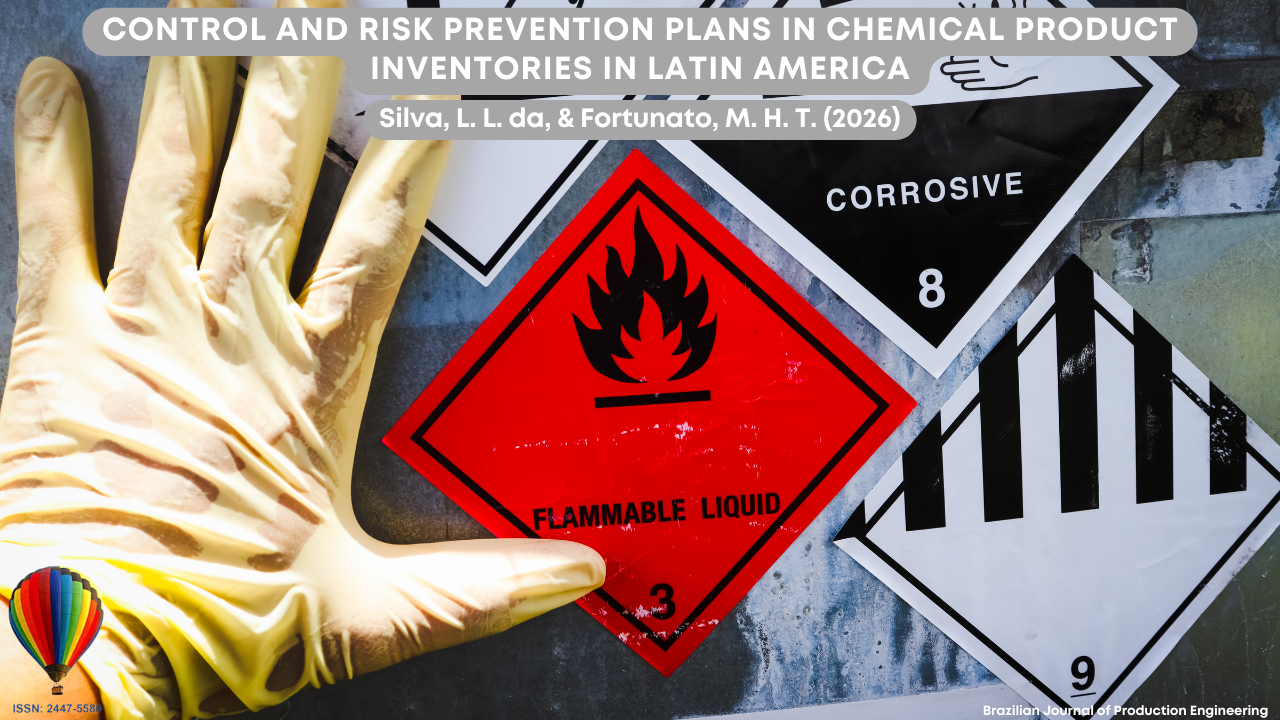
Control and risk prevention plans in chemical product inventories in Latin America
DOI:
https://doi.org/10.47456/bjpe.v12i1.50510Keywords:
Ishikawa, continuous improvement, risks, chemical safety, stakeholderAbstract
Context. The indiscriminate use of chemical substances has caused serious harm to human health and the environment. In this context, the creation and effective management of chemical inventories have become fundamental strategies for governments to align with UN guidelines and the Sustainable Development Goals of the 2030 Agenda, strengthening control and the protection of both the environment and public health. Objective. Thus, this study aimed to identify the impacts and risks faced by organizations regarding the recently implemented chemical inventories in Chile and Colombia. These two countries were chosen as references in the project to assess the risks associated with their national chemical inventories from both governmental and industrial perspectives. Method. The methodology involved a literature review and the application of questionnaires to different stakeholders in order to analyze the effects of the current regulations. Results. Based on the results, the use of the Ishikawa Diagram was proposed to identify the causes of the main problems found, enabling more consistent risk management and the continuous improvement of practices within the evaluated industries and governments. This approach promotes a systematic analysis of causes and contributes to strengthening regulatory management and the chemical sector in the region.
Downloads
References
Breuer, A., Janetschek, H., & Malerba, D. (2019). Translating Sustainable Development Goal (SDG) interdependencies into policy advice. Sustainability, 11(7), 2092. https://doi.org/10.3390/su11072092
Costa, T. B. da S. & Mendes, M. A. (2018). Análise da causa raiz: utilização do diagrama de Ishikawa e Método dos 5 Porquês para identificação das causas da baixa produtividade em uma cacauicultura. Anais do X Simpósio de Engenharia de Produção de Sergipe (SIMPROD), São Cristóvão, SE, Brasil, 1-11.
Health and Safety Authority [HSA]. (2012). 2012 Survey of Chemical Usage in Irish Workplaces. Recuperado de https://niso.ie/survey-of-chemical-usage-in-irish-workplaces/
Health and Safety Authority [HSA]. (2019). 2018 Survey on chemical usage. Recuperado de https://www.hsa.ie/eng/publications_and_forms/publications/chemical_and_hazardous_substances/?pageNumber=3
Mousseau, T. A. (2021). The biology of Chernobyl. Annual Review of Ecology, Evolution, and Systematics, 52, 87-109. https://doi.org/10.1146/annurev-ecolsys-012121-083648
Moro, A. & Invernizzi, N. (2016). A tragédia da talidomida: a luta pelos direitos das vítimas e por melhor regulação de medicamentos [Tese de Doutorado em Políticas Públicas, Universidade Federal do Paraná]. Curitiba, PR, Brasil.
Sampaio, T. B. (2022). Metodologia da pesquisa (1ª ed.). UAB/CTE/UFSM, Santa Maria, RS, Brasil. Recuperado de https://repositorio.ufsm.br/handle/1/26138
Silva, B. C. C., Trombine, J. C., & Corrêa, R. S. (2019). Aplicação das ferramentas Diagrama de Ishikawa e 5W2H: um estudo de caso em uma microempresa de móveis no sul de Minas. Dissertação de Pós-Graduação em Engenharia de Produção, Centro Universitário do Sul de Minas, MG, Brasil.
Tonussi, P. R. & Forte, L. A. (2023). A importância da gestão de riscos na indústria: uma revisão da literatura. Monografia de Graduação em Engenharia de Produção, Centro Universitário UNINTER, Santo André, SP, Brasil.
United Nations [ONU]. (1993). Report of the United Nations Conference on Environment and Development. Recuperado de https://www.un.org/en/conferences/environment/rio1992
Wang, Z., Walker, G. W., Muir, D. C. G., & Nagatani-Yoshida, K. (2020). Toward a global understanding of chemical pollution: a first comprehensive analysis of national and regional chemical inventories. Environmental Science & Technology, 54(5), 2575-2584. https://doi.org/10.1021/acs.est.9b06379
Published
Issue
Section
License
Copyright (c) 2026 Silva, L. L. da, & Fortunato, M. H. T.

This work is licensed under a Creative Commons Attribution 4.0 International License.

All works published in the Brazilian Journal of Production Engineering (BJPE) are licensed under Creative Commons Attribution 4.0 International (CC BY 4.0).
This means that:
Anyone can copy, distribute, display, adapt, remix, and even commercially use the content published in the journal;
Provided that due credit is given to the authors and to BJPE as the original source;
No additional permission is required for reuse, as long as the license terms are respected.
This policy complies with the principles of open access, promoting the broad dissemination of scientific knowledge.


2.png)