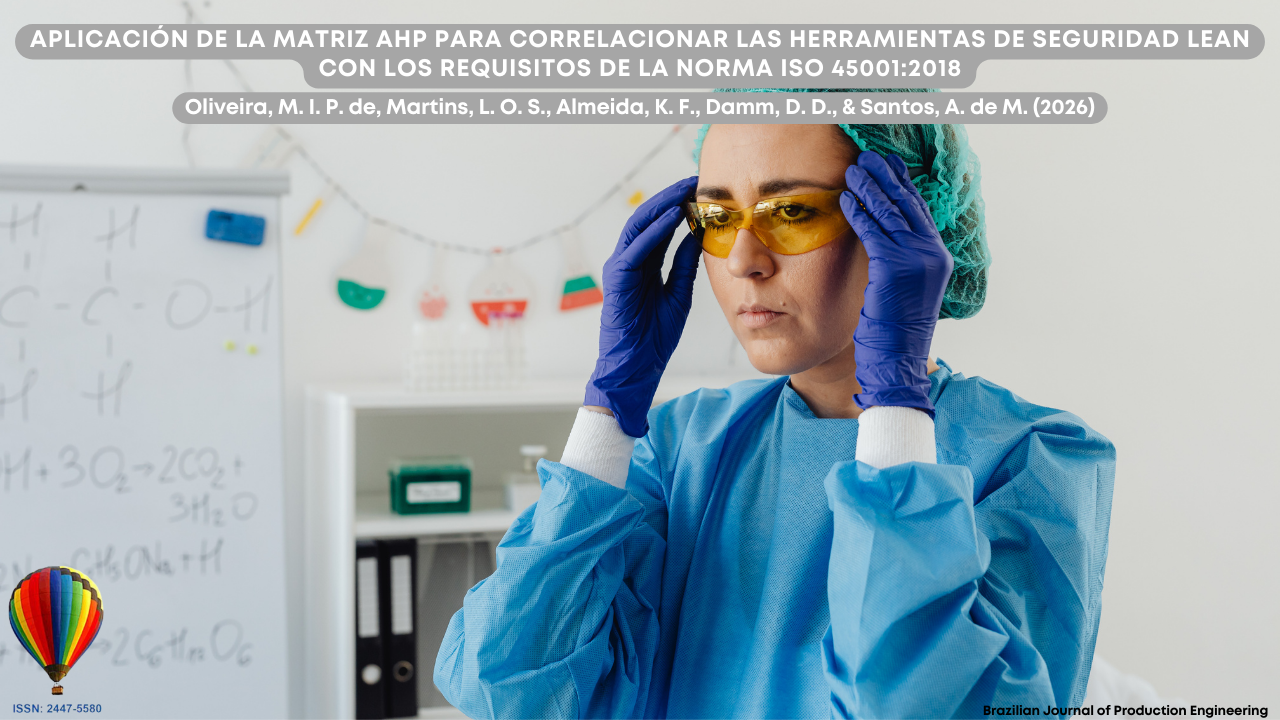
Aplicación de la Matriz AHP para correlacionar las herramientas de Seguridad Lean con los requisitos de la norma ISO 45001:2018
DOI:
https://doi.org/10.47456/bjpe.v12i1.50065Palabras clave:
Herramientas lean, ISO 45001:2018, AHPResumen
El Sistema de Gestión de Seguridad y Salud en el Trabajo implementado aporta beneficios al desempeño empresarial al establecer requisitos que garantizan la integración de la seguridad en los procesos productivos. Las herramientas lean actúan como aliadas en la implementación, compartiendo un enfoque común en el rendimiento y la seguridad. El objetivo de este estudio es aplicar el método de toma de decisiones multicriterio Proceso Analítico Jerárquico (AHP) para correlacionar las herramientas del lean safety con los requisitos de la norma ISO 45001:2018. El método aplicado consistió en las etapas del AHP: definición del problema, estructuración de la jerarquía, construcción de las matrices, comparaciones por pares y obtención de los pesos y prioridades finales. Los requisitos más relevantes identificados fueron Operación, Mejora y Planificación. Las herramientas más relevantes para estos requisitos fueron 5S, VSM, SMED y Poka Yoke. La correlación demostró la aplicabilidad de las herramientas lean safety en el proceso de certificación de la norma ISO 45001.
Descargas
Referencias
Abudabbus, A. H. M. (2024). The Effects of ISO 45001:2018 Components on Injuries and Occupational Accidents: A case study in the Dhahra field of the Waha Oil Company. Scholars Journal of Engineering and Technology, 12(08), 267-275. https://doi.org/10.36347/sjet.2024.v12i08.003
Afonso, M., Gabriel, A. T., & Godina, R. (2022). Proposal of an innovative ergonomic SMED model in an automotive steel springs industrial unit. Advances in industrial and Manufacturing Engineering, 4, 100075. https://doi.org/10.1016/J.AIME.2022.100075
Agus, P., Ratna Setyowati, P., Arman, Hj. A., Masduki, A., Innocentius, B., Priyono Budi, S., & Otta Breman, S. (2020). The Effect of Implementation Integrated Management System ISO 9001, ISO 14001, ISO 22000 and ISO 45001 on Indonesian Food Industries Performance. Test Engineering and Management, 82 (20). pp. Recuperado de http://ur.aeu.edu.my/id/eprint/747
Aksüt, G. & Eren, T. (2023). Evaluation of ergonomic criteria with an AHP-based approach in the textile industry and ordering alternatives. Industria Textila, 74(4), 453-463. https://doi.org/10.35530/IT.074.04.2022117
Aksüt, G., Eren, T., & Alakaş, H. M. (2024). Using wearable technological devices to improve workplace health and safety: an assessment on a sector base with multi-criteria decision-making methods. Ain Shams Engineering Journal, 15(2), 102423. https://doi.org/https://doi.org/10.1016/j.asej.2023.102423
Alaidaros, H., Omar, M., & Romli, R. (2021). The state of the art of agile kanban method: challenges and opportunities. Independent Journal of Management & Production, 12(8), 2535-2550. https://doi.org/10.14807/ijmp.v12i8.1482
Alfatonah, Z., Maulana Wardani, Z., Adriansyah, A. P., Salaf, F. A., Prastyo, Y., & Pelita Bangsa, U. (2024). Implementation of Kaizen culture in occupational health and safety (OHS) at PT. Automotive manufacturing Indonesia with the 5S Method. Review: Journal of Multidisciplinary in Social Sciences, 1(13), 548-556. https://doi.org/10.59422/RJMSS.V1I13.658
Amrani, A. & Ducq, Y. (2020). Lean practices implementation in aerospace based on sector characteristics: methodology and case study. Production Planning and Control, 31(16), 1313-1335. https://doi.org/10.1080/09537287.2019.1706197
Antonelli, D. & Stadnicka, D. (2018). Combining factory simulation with value stream mapping: a critical discussion. Procedia CIRP, 67, 30-35. https://doi.org/10.1016/J.PROCIR.2017.12.171
Associação Brasileira de Normas Técnicas. (2018). ABNT NBR ISO 45001:2018. Sistemas de gestão de saúde e segurança ocupacional: requisitos com orientação para uso (Norma traduzida, 47 p.). Rio de Janeiro.
Balaji, M., Dinesh, S. N., Raja, S., Subbiah, R., & Manoj Kumar, P. (2022). Lead time reduction and process enhancement for a low volume product. Materials Today: Proceedings, 62, 1722-1728. https://doi.org/10.1016/J.MATPR.2021.12.240.
Bayu Sejati, R. H., Wibisono, D., & Adhiutama, A. (2024). The collaborative approaches of the knowledge-based performance management system and lean six sigma to improve contractor productivity and safety performances. International Journal of Lean Six Sigma, (ahead-of-print). https://doi.org/10.1108/IJLSS-07-2023-0125/FULL/PDF
Bhattacharya, I. & Ramachandran, A. (2021). Lean manufacturing techniques. Implementation in Indian MSMEs and benefits realized thereof. Indian Journal of Engineering and Materials Sciences (IJEMS), 28(1), 89-101. https://doi.org/10.56042/ijems.v28i1.30113
Bittencourt, R. P. & Nepomuceno, N. S. (2022). Análise dos requisitos comuns às normas ISO 9001:2015, ISO 14001:2015 e ISO 45001:2018. Research, Society and Development, 11(4), e15811427160–e15811427160. https://doi.org/10.33448/RSD-V11I4.27160
Bizuneh, B. & Omer, R. (2024). Lean waste prioritisation and reduction in the apparel industry: application of waste assessment model and value stream mapping. Cogent Engineering, 11(1), 2341538.https://doi.org/10.1080/23311916.2024.2341538
Bravo-Paliz, J. S. & Avilés-Sacoto, S. V. (2023). Characterizing the integration of BRC food safety certification and lean tools: the case of an Ecuadorian packaging company. TQM Journal, 35(4), 872-892. https://doi.org/10.1108/TQM-05-2021-0120
Calixto, B. (2023). Análise da utilização do método AHP no processo de avaliação e priorização de riscos ocupacionais em um laboratório de ensino e pesquisa de uma instituição. (Dissertação de mestrado). Universidade Federal de Itajubá, Itajubá, MG, Brasil. Recuperado de https://bdtd.ibict.br/vufind/Record/UFEI_93eb5f1073d08b96a65df661a54a1e62
Campanelli, L. C., Ribeiro, L. D., & Campanelli, L. C. (2021). Involvement of Brazilian companies with occupational health and safety aspects and the new ISO 45001:2018. Production, 31, e20210005. https://doi.org/10.1590/0103-6513.20210005
Chahal, V., Narwal, M. S., & Kumar, S. (2021). Ranking of lean critical success factors in manufacturing industry: AHP Approach. In: C. Pandey, V. Goyat, & S. Goel (Eds.), Advances in Materials and Mechanical Engineering (pp. 411-419). Springer Singapore. https://doi.org/10.1007/978-981-16-0673-1_34
Dzięgielewska, P., Konarkowska, O., & Górny, A. (2022). Adapting an OHS management system to ISO 45001 requirements: ensuring system management effectiveness. European Research Studies Journal, XXV(1), 809-819. Recuperado de https://www.um.edu.mt/library/oar/handle/123456789/98385
Elapanda, S., Rao, U. V. A., Kumar, E. S., Raju, I. B., & Rama Rao, S. G. (2020). An analysis on application of lean framework in health and safety management for manufacturing & service organizations. Recuperado de https://papers.ssrn.com/abstract=3600689
Erusta, N. E., & Sertyesilisik, B. (2020). An investigation into improving occupational health and safety performance of construction projects through usage of BIM for Lean Management. Communications in Computer and Information Science, 1188 CCIS, 91-100. https://doi.org/10.1007/978-3-030-42852-5_8
Fernandes, J. P. R., Godina, R., & Matias, J. C. O. (2019). Evaluating the impact of 5S implementation on occupational safety in an automotive industrial unit. Springer Proceedings in Mathematics and Statistics, 281, 139-148. https://doi.org/10.1007/978-3-030-14973-4_13
Górny, A., Dzięgielewska, P., & Konarkowska, O. (2023). Management system adaptation to iso 45001 requirements: implementation of the guidelines for continuous improvement. Acta Technica Napocensis. Series: Applied Mathematics, Mechanics, And Engineering, 65(4S). Recuperado de https://atnamam.utcluj.ro/index.php/Acta/article/view/2042
Guimarães, A., Oliveira, E. e., Oliveira, M., & Pereira, T. (2025). Effects of Lean Tools and Industry 4.0 technology on productivity: An empirical study. Journal of Industrial Information Integration, 44, 100787. https://doi.org/10.1016/J.JII.2025.100787
Gupta, S. & Chandna, P. (2020). A case study concerning the 5S lean technique in a scientific equipment manufacturing company. Grey Systems, 10(3), 339-357. https://doi.org/10.1108/GS-01-2020-0004/FULL/PDF
Hamja, A., Maalouf, M., & Hasle, P. (2019). The effect of lean on occupational health and safety and productivity in the garment industry. A literature review. Production and Manufacturing Research, 7(1), 316-334. https://doi.org/10.1080/21693277.2019.1620652
Hariyani, D., Hariyani, P., Mishra, S., & Sharma, M. K. (2025). A literature review on lean tools for enhancing the quality in the outcome-based education system. Thinking Skills and Creativity, 57, 101793. https://doi.org/10.1016/J.TSC.2025.101793
Hoscan, O. & Cetinyokus, S. (2021). Determination of emergency assembly point for industrial accidents with AHP analysis. Journal of Loss Prevention in the Process Industries, 69, 104386. Recuperado de https://doi.org/10.1016/j.jlp.2020.104386.
Ichdan, D. A. (2024). Analysis of employee performance through productivity: The role of kaizen culture, motivation, and work discipline in the manufacturing industry. Annals of Human Resource Management Research, 4(1), 13–28. Recuperado de https://doi.org/10.35912/AHRMR.V4I1.2158
Janackovic, G., Stojiljkovic, E., & Grozdanovic, M. (2020). Selection of key indicators for the improvement of occupational safety system in electricity distribution companies. Safety Science, 125, 103654. https://doi.org/10.1016/J.SSCI.2017.07.009
Konrad, K., Sommer, M., & Shareef, I. (2023). Crate consolidation and standardization using lean manufacturing systems. Manufacturing Letters, 35, 1264-1275. https://doi.org/10.1016/J.MFGLET.2023.08.105
Kumar, M. B. & Parameshwaran, R. A. (2020). A comprehensive model to prioritise lean tools for manufacturing industries: a fuzzy FMEA, AHP and QFD-based approach. International Journal of Services and Operations Management, 37(2), 170-196. https://doi.org/10.1504/IJSOM.2020.110337
Kumar, M. B., Parameshwaran, R., Antony, J., & Cudney, E. (2023). Framework for Lean implementation through Fuzzy AHP-COPRAS integrated approach. IEEE Transactions on Engineering Management, 70(11), 3836-3848. https://doi.org/10.1109/TEM.2021.3089691
Kumar, N., Shahzeb Hasan, S., Srivastava, K., Akhtar, R., Kumar Yadav, R., & Choubey, V. K. (2022). Lean manufacturing techniques and its implementation: A review. Materials Today: Proceedings, 64, 1188-1192. https://doi.org/10.1016/J.MATPR.2022.03.481
Lara, A. C., Menegon, E. M. P., Sehnem, S., & Kuzma, E. (2022). Relationship between Just in Time, Lean Manufacturing, and Performance Practices: a meta-analysis. Gestão & Produção, 29, e9021. https://doi.org/10.1590/1806-9649-2022V29E9021
Liu, X., Liu, Y., Li, H., & Wen, D. (2023). Identification and analysis of barriers to the effectiveness of ISO 45001 certification in Chinese certified organisations: A DEMATEL-ISM approach. Journal of Cleaner Production, 383, 135447. https://doi.org/10.1016/J.JCLEPRO.2022.135447
Małysa, T. (2025). Application of selected Lean tools in the improvement of work safety in the use of machinery. Production Engineering Archives, 31(1), 129-136. https://doi.org/10.30657/PEA.2025.31.12
Małysa, T. & Furman, J. (2021). Application of selected lean manufacturing (LM) tools for the improvement of work safety in the steel industry. Metalurgija, 60(3-4), 434-436. Recuperado de https://hrcak.srce.hr/256129
Marques, J. P., Sá, J. C., G Silva, F. J., Pereira, T., Ferreira, L. P., & Santos, G. (2021). Safety efficiency value stream mapping (SEVSM). A new tool to support the implementation of Lean Safety. IOP Conference Series: Materials Science and Engineering, 1193(1), 012124. https://doi.org/10.1088/1757-899X/1193/1/012124
Menezes, M. de O., Sant’anna, Â, M. O., & Pimentel, C. A. (2024). Prospecção científica da aplicação do Lean Manufacturing na segurança ocupacional. Brazilian Journal of Production Engineering, (4), 213-225. https://doi.org/10.47456/BJPE.V10I4.46281
Mittal, R. & Shameem, H. (2024). A framework for lean tool selection in the label printing industry for sustainable growth. International Journal of System Assurance Engineering and Management. https://doi.org/10.1007/s13198-024-02257-3
Oliveira, M., Tavares, A., dos Santos, I., & Veroneze, G. (2022). Improvement of the process performance of a tire manufacturing company through the implementation of management tools based on the michelin manufacturing way philosophy (MMW). Proceedings on Engineering Sciences, 4(4), 397-406. https://doi.org/10.24874/PES04.04.002
Panigrahi, S., al Ghafri, K. K., al Alyani, W. R., Ali Khan, M. W., al Madhagy, T., & Khan, A. (2023). Lean manufacturing practices for operational and business performance: A PLS-SEM modeling analysis. International Journal of Engineering Business Management, 15. https://doi.org/10.1177/18479790221147864
Ratter, E., & Karcz, J. (2023). Possibilities of utilizing lean management tools in the high-level structure (HLS) concept. European Research Studies Journal, XXVI (Issue 1), 379-389. https://doi.org/10.35808/ERSJ/3117
Rocha, D. P., & Sousa, J. C. de. (2021). Gestão Da Qualidade: A Importância do Método Kanban como Ferramenta Gerencial / Quality Management: The Importance of the Kanban Method as a Management Tool. ID on Line. Revista de Psicologia, 15(55), 449-468. Recuperado de https://doi.org/10.14295/idonline.v15i55.3085
Sá, J. C., Dinis-Carvalho, J., Fraga, H., Lima, V., Silva, F. J. G., & Bastos, J. (2023). The impact of Lean on occupational safety in organisations. IFIP Advances in Information and Communication Technology, 668 IFIP, 184-192. https://doi.org/10.1007/978-3-031-25741 4_16/TABLES/2
Sá, J. C., Manuel, V., Silva, F. J. G., Santos, G., Ferreira, L. P., Pereira, T., & Carvalho, M. (2021). Lean Safety - assessment of the impact of 5S and Visual Management on safety. IOP Conference Series: Materials Science and Engineering, 1193(1), 012049. https://doi.org/10.1088/1757-899X/1193/1/012049
Sá, J. C., Sales-Contini, R. C. M., Silva, F. J. G., Dinis-Carvalho, J., Cardoso, L., & Fonseca, L. (2024). The Impact of SMED on Productivity and Safety. IFIP Advances in Information and Communication Technology, 681, 257-270. https://doi.org/10.1007/978-3-031-63265-5_20
Saaty, T. L. (2008). Decision making with the analytic hierarchy process. International Journal of Services Sciences, 1(1), 83-98. https://doi.org/10.1504/IJSSCI.2008.017590
Saaty, T. L., & Vargas, L. G. (2012). Models, methods, concepts & applications of the analytic hierarchy process (2nd ed., pp. 1-20). Springer. https://doi.org/10.1007/978-1-4614-3597-6
Sadowski, A., Jędrzejczak, R., Starzynska, D., & Engelseth, P. (2024). Using visual management to improve logistics operations. International Journal of Lean Six Sigma, 15(7), 1494-1512. https://doi.org/10.1108/IJLSS-02-2021-0032
Samanta, S., & Gochhayat, J. (2023). Critique on occupational safety and health in construction sector: An Indian perspective. Materials Today: Proceedings, 80, 3016-3021. https://doi.org/10.1016/J.MATPR.2021.05.707
Soltaninejad, M., Fardhosseini, M. S., & Kim, Y. W. (2022). Safety climate and productivity improvement of construction workplaces through the 6S system: mixed-method analysis of 5S and safety integration. International Journal of Occupational Safety and Ergonomics, 28(3), 1811-1821. https://doi.org/10.1080/10803548.2021.1935624
Taghipour, A., Hoang, P., & Cao, X. (2020). Just in time/lean purchasing approach: An investigation for research and applications. Journal of Advanced Management Science, 8(2), 43-48. https://doi.org/10.18178/joams.8.2.43-48
Tamanna, S. & Rahman, M. M. (2022). Prioritization of effective lean tools for reliability analysis & maintenance strategy. Journal of Engineering Advancements, 3(03), 112-130. https://doi.org/10.38032/JEA.2022.03.006
Trubetskaya, A., Ryan, A., & Murphy, F. (2023). An implementation model for digitisation of visual management to develop a smart manufacturing process. International Journal of Lean Six Sigma, 15(8), 32-49. https://doi.org/10.1108/IJLSS-07-2022-0156/FULL/PDF
Unver, S., & Ergenc, I. (2021). Safety risk identification and prioritize of forest logging activities using analytic hierarchy process (AHP). Alexandria Engineering Journal, 60(1), 1591-1599. https://doi.org/https://doi.org/10.1016/j.aej.2020.11.012
Yazıcı, K., Gökler, S. H., & Boran, S. (2021). An integrated SMED-fuzzy FMEA model for reducing setup time. Journal of Intelligent Manufacturing, 32(6), 1547-1561. https://doi.org/10.1007/S10845-020-01675-X/METRICS
Yeshitila, D., Kitaw, D., & Jilcha, K. (2021). Applying Lean Thinking to improve operational safety in oil and gas industry. Open Journal of Safety Science and Technology, 11(3), 120-141. https://doi.org/10.4236/OJSST.2021.113009
Publicado
Número
Sección
Licencia
Derechos de autor 2026 Menezes, M. de O., & Pimentel, C. A.

Esta obra está bajo una licencia internacional Creative Commons Atribución 4.0.

Todas las obras publicadas en la Revista Brasileña de Ingeniería de Producción (BJPE) están bajo la licencia Creative Commons Atribución 4.0 Internacional (CC BY 4.0).
Esto significa que:
Cualquier persona puede copiar, distribuir, exhibir, adaptar, remezclar e incluso utilizar comercialmente el contenido publicado en la revista;
Siempre que se reconozca debidamente a los autores y a BJPE como fuente original;
No se requiere permiso adicional para la reutilización, siempre que se respeten los términos de la licencia.
Esta política cumple con los principios de acceso abierto, promoviendo la amplia difusión del conocimiento científico.


2.png)