

2.png)
































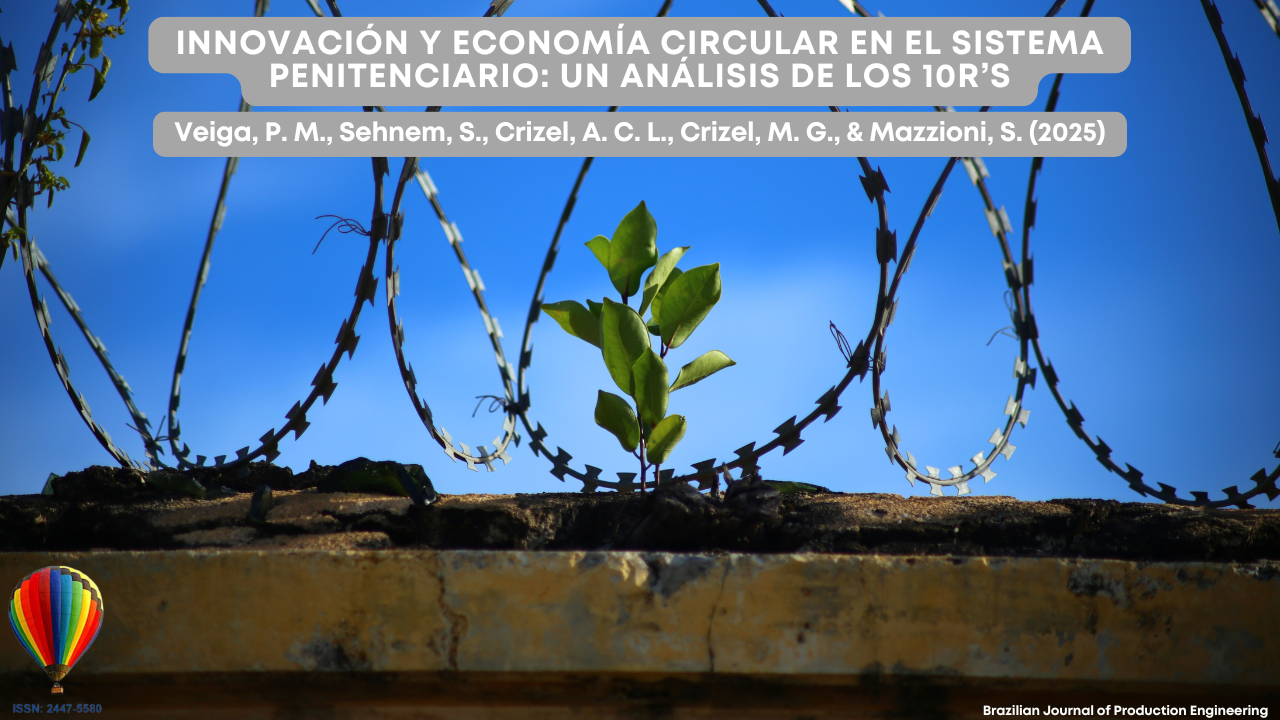
Innovación y economía circular en el sistema penitenciario: un análisis de los 10R’s
- Autores/as
-
-
Autor/a
-
Autor/a
-
Ana Cláudia Lara Crizel
Universidade Comunitária da Região de Chapecó
Autor/a
-
Marcelo Guerreiro Crizel
Universidade Comunitária da Região de Chapecó
Autor/a
-
Autor/a
-
- Palabras clave:
- Economía circular, Sistema penitenciario, Innovación, Sostenibilidad, 10Rs
- Resumen
-
Este estudio investiga la aplicación de las estrategias de los 10R como alternativa impulsada por la innovación para avanzar en la economía circular en las prisiones del estado de Santa Catarina. Se adoptó un estudio de caso único cualitativo, triangulando datos de revisión sistemática de la literatura, 16 entrevistas semiestructuradas con administradores penitenciarios y observaciones directas. Los resultados muestran que, a pesar de algunas prácticas sostenibles aisladas, existe una falta de coordinación institucional, conciencia de las partes interesadas y capacitación técnica. Se identificaron la innovación tecnológica, las herramientas digitales y la reorganización de las rutinas organizacionales como facilitadores de la circularidad.
- Biografía del autor/a
- Referencias
-
Allwood, J. M., Ashby, M. F., Gutowski, T. G., & Worrell, E. (2011). Material efficiency: a white paper. Resources, Conservation and Recycling, 55(3), 362-381. https://doi.org/10.1016/j.resconrec.2010.11.002
Bardin, L. (2011). Análise de conteúdo. São Paulo, SP: Edições 70.
Blackburn, R. (2004). Remanufacturing in the UK: A significant contributor to sustainable development? Journal of Cleaner Production, 12(8–10), 1129–1140. https://doi.org/10.1016/j.jclepro.2004.02.020
Braungart, M., & McDonough, W. (1998). The next industrial revolution. The Atlantic Monthly, 282(4), 82–92.
Brasil. (1984). Lei nº 7.210, de 11 de julho de 1984 (Lei de Execução Penal). Dispõe sobre a execução penal. Recuperado de https://www.planalto.gov.br/ccivil_03/leis/l7210.htm
Brasil. (1940). Decreto-Lei nº 2.848, de 7 de dezembro de 1940 (Código Penal Brasileiro). Recuperado de https://www.planalto.gov.br/ccivil_03/decreto-lei/del2848compilado.htm
Brasil. (2005). Resolução nº 3, de 23 de setembro de 2005. Diretrizes básicas para arquitetura penal. Recuperado de https://www.gov.br/depen/pt-br/composicao/cnpcp/resolucoes/2011/diretrizes-basicas-para-arquitetura-penal.pdf
Brundtland, G. H. (1987). Our common future: Report of the World Commission on Environment and Development. Oxford: Oxford University Press.
Cossu, R., & Williams, I. D. (2015). Urban mining: Concepts, terminology, challenges. Waste Management & Research, 33(6), 478–479. https://doi.org/10.1177/0734242X15588305
Ellen MacArthur Foundation. (2013). Towards the circular economy: Opportunities for the consumer goods sector. https://www.ellenmacarthurfoundation.org
Ellen MacArthur Foundation. (2015). Towards the circular economy: The business rationale to accelerate the transition. https://www.ellenmacarthurfoundation.org
Francis, C. A., Lieblein, G., Gliessman, S. R., Breland, T. A., Creamer, N. G., Harwood, R. R., ... & Wiedenhoeft, M. H. (2003). Agroecology: The ecology of food systems. Journal of Sustainable Agriculture, 22(3), 99–118. https://doi.org/10.1300/J064v22n03_10
Geissdoerfer, M., Savaget, P., Bocken, N. M. P., & Hultink, E. J. (2017). The Circular Economy–A new sustainability paradigm? Journal of Cleaner Production, 143, 757–768. https://doi.org/10.1016/j.jclepro.2016.12.048
Ghisellini, P., Cialani, C., & Ulgiati, S. (2016). A review on circular economy: The expected transition to a balanced interaction of environmental and economic systems. Journal of Cleaner Production, 114, 11–32. https://doi.org/10.1016/j.jclepro.2015.09.007
Ghisellini, P., Ripa, M., & Ulgiati, S. (2014). Sustainable waste management: A case study of Italy. Journal of Cleaner Production, 33, 58–66. https://doi.org/10.1016/j.jclepro.2012.09.013
Goodman, J., Korsunova, A., & Halme, M. (2017). Our collaborative future: Stakeholder roles and agendas in sustainability innovation. Business Strategy and the Environment, 26(6), 731–753. https://doi.org/10.1002/bse.1941
Hultman, J., & Corvellec, H. (2012). The European waste hierarchy: From the sociomateriality of waste to a politics of consumption. Environment and Planning A, 44(10), 2413–2427. https://doi.org/10.1068/a44668
Kirchherr, J., Reike, D., & Hekkert, M. (2017). Conceptualizing the circular economy: An analysis of 114 definitions. Resources, Conservation and Recycling, 127, 221–232. https://doi.org/10.1016/j.resconrec.2017.09.005
Kruglianskas, I., & Pinsky, V. (2018). Inovação tecnológica para a sustentabilidade: lições de sucessos e fracassos. Estudos Avançados, 31(90), 107–126. https://doi.org/10.1590/s0103-40142017.3190008
Lieder, M., & Rashid, A. (2016). Towards circular economy implementation: A comprehensive review in context of manufacturing industry. Journal of Cleaner Production, 115, 36–51. https://doi.org/10.1016/j.jclepro.2015.12.042
Merli, R., Preziosi, M., & Acampora, A. (2018). How do scholars approach the circular economy? A systematic review of the literature. Journal of Cleaner Production, 178, 703–722. https://doi.org/10.1016/j.jclepro.2017.12.112
Mies, A., & Gold, S. (2021). Mapping the social dimension of the circular economy. Journal of Cleaner Production, 321, 128960. https://doi.org/10.1016/j.jclepro.2021.128960
Murray, A., Skene, K., & Haynes, K. (2017). The circular economy: An interdisciplinary exploration of the concept and application in a global context. Journal of Business Ethics, 140(3), 369–380. https://doi.org/10.1007/s10551-015-2693-2
Reike, D., Vermeulen, W. J. V., & Witjes, S. (2018). The circular economy: New or refurbished as CE 3.0? Exploring controversies in the conceptualization of the circular economy through a focus on history and resource value retention options. Resources, Conservation and Recycling, 135, 246–264. https://doi.org/10.1016/j.resconrec.2017.08.027
Rodwell, M. K. (1994). Social work constructivist research. New York: Garland Publishing.
Roper, S., Hopkinson, P., Zils, M., & Hawkins, P. (2018). Managing a complex global circular economy business model: Opportunities and challenges. California Management Review, 60(3), 71–94. https://doi.org/10.1177/0008125618764692
Santa Catarina. (2019). Lei Complementar nº 741, de 12 de junho de 2019. Dispõe sobre a estrutura organizacional básica da Administração Pública Estadual. Recuperado de http://leis.alesc.sc.gov.br/html/2019/741_2019_lei_complementar.html
Santa Catarina. (2021). Lei Complementar nº 774, de 27 de outubro de 2021. Dispõe sobre o Estatuto da Polícia Penal do Estado de Santa Catarina. Recuperado de http://leis.alesc.sc.gov.br/html/2021/774_2021_lei_complementar.html
Santa Catarina. (2022). Decreto nº 2.379, de 28 de dezembro de 2022. Aprova o Regimento Interno da Secretaria de Estado da Administração Prisional e Socioeducativa. Recuperado de https://leisestaduais.com.br/sc/decreto-n-2379-2022-santa-catarina-aprova-o-regimento-interno-da-secretaria-de-estado-da-administracao-prisional-e-socio-educational
Santa Catarina. (2007). Lei nº 14.003, de 3 de maio de 2007. Dispõe sobre o Conselho Penitenciário Estadual. Recuperado de http://leis.alesc.sc.gov.br/html/2007/14003_2007_Lei.html
Secchim, A. B., Freitas, R. R., & Gonçalves, W. (2018). Mapeamento e análise bibliométrica da utilização da análise envoltória de dados (DEA) em estudos de engenharia de produção. Brazilian Journal of Production Engineering, 4(2), 87–108. https://doi.org/10.47456/bjpe.v4i2.24464
Valencia, M., Bocken, N. M. P., Loaiza, C., & Jaeger, S. (2023). The social contribution of the Circular Economy. Journal of Cleaner Production, 408, 137082. https://doi.org/10.1016/j.jclepro.2023.137082
Vygotsky, L. S. (2001). A construção do pensamento e da linguagem. São Paulo, SP: Martins Fontes.
Yan, J., & Feng, C. (2014). Sustainable design-oriented product modularity combined with the 6R concept: A rotor laboratory bench case study. Clean Technologies and Environmental Policy, 16(1), 89–101. https://doi.org/10.1007/s10098-013-0597-3
Yin, R. K. (2015). Estudo de caso: Planejamento e métodos (5ª ed.). Porto Alegre, RS: Bookman.
- Cover Image
-
- Publicado
- 2025-09-25
- Sección
- GESTIÓN PÚBLICA
- Licencia
-
Derechos de autor 2025 Veiga, P. M., Sehnem, S., Crizel, A. C. L., Crizel, M. G., & Mazzioni, S.

Esta obra está bajo una licencia internacional Creative Commons Atribución 4.0.
Todas las obras publicadas en la Revista Brasileña de Ingeniería de Producción (BJPE) están bajo la licencia Creative Commons Atribución 4.0 Internacional (CC BY 4.0). Esto significa que: Cualquier persona puede copiar, distribuir, exhibir, adaptar, remezclar e incluso utilizar comercialmente el contenido publicado en la revista; Siempre que se reconozca debidamente a los autores y a BJPE como fuente original; No se requiere permiso adicional para la reutilización, siempre que se respeten los términos de la licencia. Esta política cumple con los principios de acceso abierto, promoviendo la amplia difusión del conocimiento científico. 🔗 Haga clic aquí para acceder a la licencia completa.
