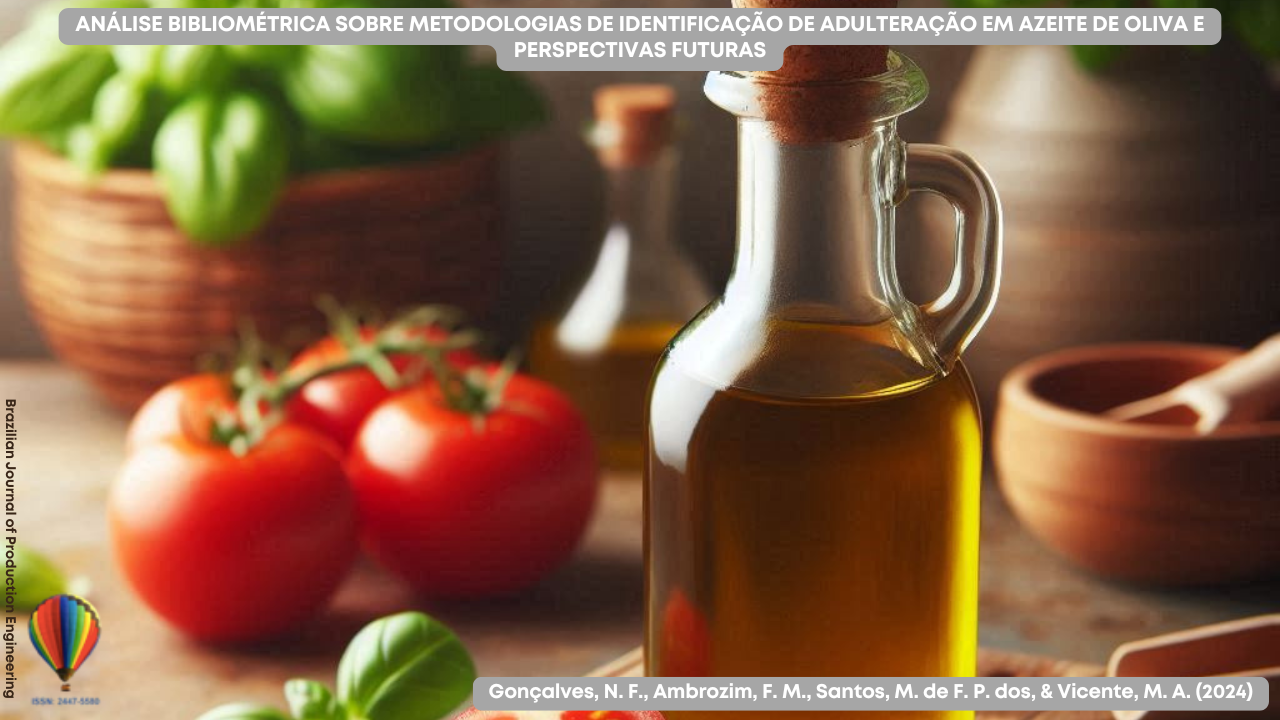
Análise bibliométrica sobre metodologias de identificação de adulteração em azeite de oliva e perspectivas futuras
DOI:
https://doi.org/10.47456/bjpe.v10i4.45570Palavras-chave:
Adulteração, Azeite de oliva, IdentificaçãoResumo
Azeite de oliva extravirgem é um produto vulnerável a diversos tipos de adulteração como ser misturado com outros óleos vegetais ou azeites de qualidade inferior. Diversas técnicas analíticas têm sido descritas para detectar a adulteração de azeite, mas com limitadas aplicações. Nesse contexto, este trabalho realizou uma análise bibliométrica sobre as metodologias para identificar adulteração em azeite de oliva. Foi utilizado o banco de dados da Web of Science no período de 2000 a 2024 e as palavras-chave “olive oil”, “adulteration” e “detection”, dentre outros critérios. Os resultados mostraram crescimento exponencial no número de publicações no período avaliado. Ciência e Tecnologia de Alimentos (66) e Química Aplicada (52) foram as categorias com maior número de artigos. Os principais periódicos foram Food Chemistry e Journal of Agricultural and Food. Os países que mais contribuíram com pesquisas sobre o tema foram a Espanha, China e Itália com 55, 40 e 33 artigos, respectivamente. As palavras-chave de maior força de conexão foram adulteração (668), óleos vegetais (406), azeite (370), autenticação (335) e classificação (245). No atual cenário de mudanças climáticas e eventos extremos, o desenvolvimento de metodologias para a rastreabilidade e autenticidade do produto será importante para a segurança alimentar e econômica.
Downloads
Referências
Arroyo-Cerezo, A., Yang, X., Jiménez-Carvelo, A. M., Pellegrino, M., Felicita Savino, A., & Berzaghi, P. (2024). Assessment of extra virgin olive oil quality by miniaturized near infrared instruments in a rapid and non-destructive procedure. Food chemistry, 430, 137043. https://doi.org/10.1016/j.foodchem.2023.137043 DOI: https://doi.org/10.1016/j.foodchem.2023.137043
Baeten, V., Fernández Pierna, J. A., Dardenne, P., Meurens, M., García-González, D. L., & Aparicio-Ruiz, R. (2005). Detection of the presence of hazelnut oil in olive oil by FT-raman and FT-MIR spectroscopy. Journal of agricultural and food chemistry, 53(16), 6201–6206. https://doi.org/10.1021/jf050595n DOI: https://doi.org/10.1021/jf050595n
Blasi, F., Ianni, F., & Cossignani, L. (2024). Phenolic profiling for geographical and varietal authentication of extra virgin olive oil, Trends in Food Science & Technology, 147, 104444. https://doi.org/10.1016/j.tifs.2024.104444 DOI: https://doi.org/10.1016/j.tifs.2024.104444
Bouzembrak, Y., Steen, B., Neslo, R., Linge, J., Mojtahed, V., Marvin, H.J.P. (2018) Development of food fraud media monitoring system based on text mining, Food Control, 93, 283-296. https://doi.org/10.1016/j.foodcont.2018.06.003 DOI: https://doi.org/10.1016/j.foodcont.2018.06.003
Cecchi, L., Migliorini, M., & Mulinacci, N. (2021). Virgin Olive Oil Volatile Compounds: Composition, Sensory Characteristics, Analytical Approaches, Quality Control, and Authentication. Journal of agricultural and food chemistry, 69(7), 2013–2040. https://doi.org/10.1021/acs.jafc.0c07744 DOI: https://doi.org/10.1021/acs.jafc.0c07744
Christopoulou, E., Lazaraki, M., Komaitis, M., & Kaselimis, K. (2004). Effectiveness of determinations of fatty acids and triglycerides for the detection of adulteration of olive oils with vegetable oils, Food Chemistry, 84(3), 463-474. https://doi.org/10.1016/S0308-8146(03)00273-5 DOI: https://doi.org/10.1016/S0308-8146(03)00273-5
Christy, A. A., Kasemsumran, S., Du, Y., & Ozaki, Y. (2004). The detection and quantification of adulteration in olive oil by near-infrared spectroscopy and chemometrics. Analytical sciences: the international journal of the Japan Society for Analytical Chemistry, 20(6), 935-940. https://doi.org/10.2116/analsci.20.935 DOI: https://doi.org/10.2116/analsci.20.935
de Carvalho, I. M., da Silva Mutz, Y., Machado, A. C. G., de Lima Santos, A. A., Magalhães, E. J., & Nunes, C. A. (2023). Exploring Strategies to Mitigate the Lightness Effect on the Prediction of Soybean Oil Content in Blends of Olive and Avocado Oil Using Smartphone Digital Image Colorimetry. Foods (Basel, Switzerland), 12(18), 3436. https://doi.org/10.3390/foods12183436 DOI: https://doi.org/10.3390/foods12183436
Drakopoulou, S. K., Kritikou, A. S., Baessmann, C., & Thomaidis, N. S. (2024). Untargeted 4D-metabolomics using Trapped Ion Mobility combined with LC-HRMS in extra virgin olive oil adulteration study with lower-quality olive oils. Food chemistry, 434, 137410. https://doi.org/10.1016/j.foodchem.2023.137410 DOI: https://doi.org/10.1016/j.foodchem.2023.137410
El-Abassy, R. M., Donfack, P. & Materny, A. (2009). Visible Raman spectroscopy for the discrimination of olive oils from different vegetable oils and the detection of adulteration. Journal of Raman Spectroscopy. 40, 1284-1289. https://doi.org/10.1002/jrs.2279 DOI: https://doi.org/10.1002/jrs.2279
Ergönül, P. G. & Köseoğlu, O. (2013). Changes in α-, β-, γ- and δ-tocopherol contents of mostly consumed vegetable oils during refining process. CyTA-Journal of Food, 12(2), 199–202. https://doi.org/10.1080/19476337.2013.821672 DOI: https://doi.org/10.1080/19476337.2013.821672
Eriotou, E., Karabagias, I. K., Maina, S., Koulougliotis, D., & Kopsahelis, N. (2021). Geographical origin discrimination of "Ntopia" olive oil cultivar from Ionian islands using volatile compounds analysis and computational statistics. European food research and technology = Zeitschrift fur Lebensmittel-Untersuchung und -Forschung. A, 247(12), 3083–3098. https://doi.org/10.1007/s00217-021-03863-2 DOI: https://doi.org/10.1007/s00217-021-03863-2
Everstine, K. D., Chin, H. B., Lopes, F. A., & Moore, J. C. (2024). Database of Food Fraud Records: Summary of Data from 1980 to 2022. Journal of food protection, 87(3), 100227. https://doi.org/10.1016/j.jfp.2024.100227 DOI: https://doi.org/10.1016/j.jfp.2024.100227
Fiehn O. (2001). Combining genomics, metabolome analysis, and biochemical modelling to understand metabolic networks. Comparative and functional genomics, 2(3), 155–168. https://doi.org/10.1002/cfg.82 DOI: https://doi.org/10.1002/cfg.82
Fragaki, G., Spyros, A., Siragakis, G., Salivaras, E., & Dais, P. (2005). Detection of extra virgin olive oil adulteration with lampante olive oil and refined olive oil using nuclear magnetic resonance spectroscopy and multivariate statistical analysis. Journal of agricultural and food chemistry, 53(8), 2810–2816. https://doi.org/10.1021/jf040279t DOI: https://doi.org/10.1021/jf040279t
Frankel E. N. (2010). Chemistry of extra virgin olive oil: adulteration, oxidative stability, and antioxidants. Journal of agricultural and food chemistry, 58(10), 5991–6006. https://doi.org/10.1021/jf1007677 DOI: https://doi.org/10.1021/jf1007677
Frigerio, J., Campone, L., Giustra, M. D., Buzzelli, M., Piccoli, F., Galimberti, A., Cannavacciuolo, C., Ouled Larbi, M., Colombo, M., Ciocca, G., & Labra, M. (2024). Convergent technologies to tackle challenges of modern food authentication. Heliyon, 10(11), e32297. https://doi.org/10.1016/j.heliyon.2024.e32297 DOI: https://doi.org/10.1016/j.heliyon.2024.e32297
Gurdeniz, G. & Ozen, B. (2009). Detection of adulteration of extra-virgin olive oil by chemometric analysis of mid-infrared spectral data. Food Chemistry, 116(2), 519-525. https://doi.org/10.1016/j.foodchem.2009.02.068 DOI: https://doi.org/10.1016/j.foodchem.2009.02.068
Haider, A., Iqbal, S. Z., Bhatti, I. A., Alim, M. B., Waseem, M., Iqbal, M., & Mousavi Khaneghah, A. (2024). Food authentication, current issues, analytical techniques, and future challenges: A comprehensive review. Comprehensive reviews in food science and food safety, 23(3), e13360. https://doi.org/10.1111/1541-4337.13360 DOI: https://doi.org/10.1111/1541-4337.13360
Hashempour-Baltork, F., Zade, S. V., Mazaheri, Y., Alizadeh, A.M., Rastegar, H., Abdian, Z., Torbati, M., & Damirchi, S.A. (2024). Recent methods in detection of olive oil adulteration: State-of- the-Art, Journal of Agriculture and Food Research, 16, 101123. https://doi.org/10.1016/j.jafr.2024.101123 DOI: https://doi.org/10.1016/j.jafr.2024.101123
Hassan, W. & Duarte, A. E. (2024). Bibliometric analysis: A few suggestions. Current problems in cardiology, 49(8), 102640. https://doi.org/10.1016/j.cpcardiol.2024.102640 DOI: https://doi.org/10.1016/j.cpcardiol.2024.102640
Ho, Y.S. (2014). Classic articles on social work field in Social Science Citation Index: a bibliometric analysis. Scientometrics 98, 137–155. https://doi.org/10.1007/s11192-013-1014-8 DOI: https://doi.org/10.1007/s11192-013-1014-8
Huang, Y., Guan, Q., Zhang, Z., Wang, P., & Li, C. (2024). Oleacein: A comprehensive review of its extraction, purification, absorption, metabolism, and health effects. Food chemistry, 433, 137334. https://doi.org/10.1016/j.foodchem.2023.137334 DOI: https://doi.org/10.1016/j.foodchem.2023.137334
IOC (2021) - International Olive Council. Recuperado de https://www.internationaloliveoil.org/wp-content/uploads/2021/05/IOC-Imports-2020-21.html
IOC (2024) Olive oil production statistics. Recuperado de https://www.internationalo liveoil.org/wp-content/uploads/2022/12/IOC-Olive-Oil-Dashboa rd-2.html#production-1
Jabeur, H., Drira, M., Rebai, A., & Bouaziz, M. (2017). Putative Markers of Adulteration of Higher-Grade Olive Oil with Less Expensive Pomace Olive Oil Identified by Gas Chromatography Combined with Chemometrics. Journal of agricultural and food chemistry, 65(26), 5375–5383. https://doi.org/10.1021/acs.jafc.7b00687 DOI: https://doi.org/10.1021/acs.jafc.7b00687
Jiménez, A., Rufo, M., Paniagua, J. M., González-Mohino, A., & Olegario, L. S. (2023). Authentication of pure and adulterated edible oils using non-destructive ultrasound. Food chemistry, 429, 136820. https://doi.org/10.1016/j.foodchem.2023.136820 DOI: https://doi.org/10.1016/j.foodchem.2023.136820
Jiménez, A., Rufo, M., Paniagua, J. M., González-Mohino, A., & Olegario, L. S. (2024). Temperature dependence of acoustic parameters in pure and blended edible oils: Implications for characterization and authentication. Ultrasonics, 138, 107216. https://doi.org/10.1016/j.ultras.2023.107216 DOI: https://doi.org/10.1016/j.ultras.2023.107216
Jimenez-Lopez, C., Carpena, M., Lourenço-Lopes, C., Gallardo-Gomez, M., Lorenzo, J. M., Barba, F. J., Prieto, M. A., & Simal-Gandara, J. (2020). Bioactive Compounds and Quality of Extra Virgin Olive Oil. Foods (Basel, Switzerland), 9(8), 1014. https://doi.org/10.3390/foods9081014 DOI: https://doi.org/10.3390/foods9081014
Kaldeli, A., Zakidou, P., & Paraskevopoulou, A. (2024). Volatilomics as a tool to ascertain food adulteration, authenticity, and origin. Comprehensive reviews in food science and food safety, 23(4), e13387. https://doi.org/10.1111/1541-4337.13387 DOI: https://doi.org/10.1111/1541-4337.13387
Kalua, C. M., Allen, M. S., Bedgoog, D. R., Bishop, A. G., Prenzler, P. D., & Robards, K. (2007). Olive oil volatile compounds, flavour development and quality: A critical review. Food Chemistry, 100, 273–286. https://doi.org/10.1016/j.foodchem.2005.09.059 DOI: https://doi.org/10.1016/j.foodchem.2005.09.059
Kurtoğlu, S., Uzundumlu, A. S. & Gövez, E. (2024). Olive Oil Production Forecasts for a Macro Perspective during 2024–2027. Applied Fruit Science 66, 1089–1100. https://doi-org.ez43.periodicos.capes.gov.br/10.1007/s10341-024-01064-1 DOI: https://doi.org/10.1007/s10341-024-01064-1
López-Feria, S., Cárdenas, S., García-Mesa, J. A., & Valcárcel, M. (2008). Classification of extra virgin olive oils according to the protected designation of origin, olive variety and geographical origin. Talanta, 75(4), 937–943. https://doi.org/10.1016/j.talanta.2007.12.033 DOI: https://doi.org/10.1016/j.talanta.2007.12.033
Lozano-Castellón, J., López-Yerena, A., Domínguez-López, I., Siscart-Serra, A., Fraga, N., Sámano, S., López-Sabater, C., Lamuela-Raventós, R. M., Vallverdú-Queralt, A., & Pérez, M. (2022). Extra virgin olive oil: A comprehensive review of efforts to ensure its authenticity, traceability, and safety. Comprehensive reviews in food science and food safety, 21(3), 2639–2664. https://doi.org/10.1111/1541-4337.12949 DOI: https://doi.org/10.1111/1541-4337.12949
Luki´c, M., Luki´c, I., & Moslavac, T. (2021). Sterols and Triterpene Diols in Virgin Olive Oil: A Comprehensive Review on Their Properties and Significance, with a Special Emphasis on the Influence of Variety and Ripening Degree. Horticulturae 7, 493. https://doi.org/10.3390/horticulturae7110493 DOI: https://doi.org/10.3390/horticulturae7110493
Marcos Lorenzo, I., Pérez Pavón, J. L., Fernández Laespada, M. E., García Pinto, C., & Moreno Cordero, B. (2002). Detection of adulterants in olive oil by headspace-mass spectrometry. Journal of chromatography. A, 945(1-2), 221–230. https://doi.org/10.1016/s0021-9673(01)01502-3 DOI: https://doi.org/10.1016/S0021-9673(01)01502-3
Meenu, M., Cai, Q., & Xu, B. (2019). A critical review on analytical techniques to detect adulteration of extra virgin olive oil. Trends in Food Science & Technology. 91, 391-408. https://doi.org/10.1016/j.tifs.2019.07.045 DOI: https://doi.org/10.1016/j.tifs.2019.07.045
Meenu, M., Kurade, C., Neelapu, B. C., Kalra, S., Ramaswamy, H. S., & Yu, Y. (2021). A concise review on food quality assessment using digital image processing. Trends in Food Science & Technology. 118(Pt A), 106-124. https://doi.org/10.1016/j.tifs.2021.09.014 DOI: https://doi.org/10.1016/j.tifs.2021.09.014
Meng, X., Yin, C., Yuan, L., Zhang, Y., Ju, Y., Xin, K., Chen, W., Lv, K., & Hu, L. (2023). Rapid detection of adulteration of olive oil with soybean oil combined with chemometrics by Fourier transform infrared, visible-near-infrared and excitation-emission matrix fluorescence spectroscopy: A comparative study. Food chemistry, 405(Pt A), 134828. https://doi.org/10.1016/j.foodchem.2022.134828 DOI: https://doi.org/10.1016/j.foodchem.2022.134828
Milanez, K. D. T. M. & Pontes, M. J. C. (2014). Classification of edible vegetable oil using digital image and pattern recognition techniques. Microchemical Journal. 113, 10-16. https://doi.org/10.1016/j.microc.2013.10.011 DOI: https://doi.org/10.1016/j.microc.2013.10.011
Mínguez-Mosquera, M.I., Gandul-Rojas, B., Montano-Asquerino, A., & Garrido-Fernández, J. (1991). Determination of chlorophylls and carotenoids by high-performance liquid chromatography during olive lactic fermentation. Journal of Chromatography A. 585(2), 259-266. https://doi.org/10.1016/0021-9673(91)85086-U DOI: https://doi.org/10.1016/0021-9673(91)85086-U
Moed, H. F. (2010). Measuring contextual citation impact of scientific journals. Journal of Informetrics. 4(3), 265-277. https://doi.org/10.1016/j.joi.2010.01.002 DOI: https://doi.org/10.1016/j.joi.2010.01.002
Nikou, T., Witt, M., Stathopoulos, P., Barsch, A., & Halabalaki, M. (2020). Olive Oil Quality and Authenticity Assessment Aspects Employing FIA-MRMS and LC-Orbitrap MS Metabolomic Approaches. Frontiers in public health, 8, 558226. https://doi.org/10.3389/fpubh.2020.558226 DOI: https://doi.org/10.3389/fpubh.2020.558226
Olmo-García, L. & Carrasco-Pancorbo, A. (2021) Chromatography-MS based metabolomics applied to the study of virgin olive oil bioactive compounds: Characterization studies, agro-technological investigations and assessment of healthy Properties. TrAC Trends in Analytical Chemistry. 135, 116153. https://doi.org/10.1016/j.trac.2020.116153 DOI: https://doi.org/10.1016/j.trac.2020.116153
Ordoudi, S. A., Özdikicierler O., & Tsimidou, M. Z. (2022). Detection of ternary mixtures of virgin olive oil with canola, hazelnut or safflower oils via non-targeted ATR-FTIR fingerprinting and chemometrics. Food Control. 142, 109240. https://doi.org/10.1016/j.foodcont.2022.109240 DOI: https://doi.org/10.1016/j.foodcont.2022.109240
Roca, M., Gandul-Rojas, B., Gallardo-Guerrero, L., & Minguez-Mosquera, M.I. (2003). Pigment parameters determining Spanish virgin olive oil authenticity: stability during storage. Journal of the American Oil Chemists' Society. 80(12), 1237-1240. https://doi.org/10.1007/s11746-003-0848-0 DOI: https://doi.org/10.1007/s11746-003-0848-0
Romani, A., Ieri, F., Urciuoli, S., Noce, A., Marrone, G., Nediani, C., & Bernini, R. (2019). Health Effects of Phenolic Compounds Found in Extra-Virgin Olive Oil, By-Products, and Leaf of Olea europaea L. Nutrients, 11(8), 1776. https://doi.org/10.3390/nu11081776 DOI: https://doi.org/10.3390/nu11081776
Sudhakar, A., Chakraborty, S. K., Mahanti, N. K., & Varghese, C. (2023). Advanced techniques in edible oil authentication: A systematic review and critical analysis. Critical reviews in food science and nutrition, 63(7), 873-901. https://doi.org/10.1080/10408398.2021.1956424 DOI: https://doi.org/10.1080/10408398.2021.1956424
Torres-Cobos, B., Quintanilla-Casas, B., Vicario, G., Guardiola, F., Tres, A., & Vichi, S. (2023). Revealing adulterated olive oils by triacylglycerol screening methods: Beyond the official method. Food chemistry, 409, 135256. https://doi.org/10.1016/j.foodchem.2022.135256 DOI: https://doi.org/10.1016/j.foodchem.2022.135256
Uncu, O. & Ozen, B. (2019). A comparative study of mid-infrared, UV–Visible and fluorescence spectroscopy in combination with chemometrics for the detection of adulteration of fresh olive oils with old olive oils. Food Control. 105, 209-218. https://doi.org/10.1016/j.foodcont.2019.06.013 DOI: https://doi.org/10.1016/j.foodcont.2019.06.013
Uncu, O. & Ozen, B. (2020). Importance of some minor compounds in olive oil authenticity and quality. Trends in Food Science & Technology. 100, 164–176. https://doi.org/10.1016/j.tifs.2020.04.013 DOI: https://doi.org/10.1016/j.tifs.2020.04.013
Vaclavik, L., Cajka, T., Hrbek, V., & Hajslova, J. (2009). Ambient mass spectrometry employing direct analysis in real time (DART) ion source for olive oil quality and authenticity assessment. Analytica chimica acta, 645 (1-2), 56–63. https://doi.org/10.1016/j.aca.2009.04.043 DOI: https://doi.org/10.1016/j.aca.2009.04.043
Van Eck, N. J. & Waltman, L. (2010). Software survey: VOSviewer, a computer program for bibliometric mapping. Scientometrics, 84(2), 523-538. https://doi.org/10.1007/S11192-009-0146-3 DOI: https://doi.org/10.1007/s11192-009-0146-3
Vieira, L. S., Assis, C., de Queiroz, M. E. L. R., Neves, A. A., & de Oliveira, A. F. (2021). Building robust models for identification of adulteration in olive oil using FT-NIR, PLS-DA and variable selection. Food chemistry, 345, 128866. https://doi.org/10.1016/j.foodchem.2020.128866 DOI: https://doi.org/10.1016/j.foodchem.2020.128866
Vigli, G., Philippidis, A., Spyros, A., & Dais, P. (2003). Classification of edible oils by employing 31P and 1H NMR spectroscopy in combination with multivariate statistical analysis. A proposal for the detection of seed oil adulteration in virgin olive oils. Journal of agricultural and food chemistry, 51(19), 5715–5722. https://doi.org/10.1021/jf030100z DOI: https://doi.org/10.1021/jf030100z
Downloads
Publicado
Edição
Seção
Licença
Copyright (c) 2024 Nathália Fernandes Gonçalves, Flaviane Mendonça Ambrozim, Maria de Fátima Pereira dos Santos, Maristela Araújo Vicente (Autor)

Este trabalho está licenciado sob uma licença Creative Commons Attribution 4.0 International License.

Todos os trabalhos publicados na Brazilian Journal of Production Engineering (BJPE) estão licenciados sob a Creative Commons Atribuição 4.0 Internacional (CC BY 4.0).
Isso significa que:
-
Qualquer pessoa pode copiar, distribuir, exibir, adaptar, remixar e até utilizar comercialmente os conteúdos publicados na revista;
-
Desde que sejam atribuídos os devidos créditos aos autores e à BJPE como fonte original;
-
Não é exigida permissão adicional para reutilização, desde que respeitados os termos da licença.
Esta política está em conformidade com os princípios do acesso aberto, promovendo a ampla disseminação do conhecimento científico.


2.png)